
Your firewall is not the weak point anymore. Your vendor’s intern with a reused password is. Here is what third party risk actually looks like in 2026, and how Pakistani businesses are closing the gap.
In June 2025, a procurement vendor called Chain IQ was breached. It was not the target. Its clients were. Within days, employee records from UBS and Pictet were on the dark web, including the direct phone number of a UBS executive. Nobody attacked UBS. They attacked the vendor UBS trusted.
This is not a rare scenario anymore. It is the default attack pattern of 2026. Businesses in Karachi, Lahore, and Islamabad are spending real money on firewalls, endpoint protection, and staff training, while the door they never checked, their vendor’s door, stays wide open.
This guide breaks down how third party risk actually works, what it costs, and how to build a vendor risk program that holds up when regulators, insurers, or customers come asking.
30%of all breaches in 2025 involved a third party, double the year before
5.28average downstream victims created by a single vendor breach
117days average delay before a vendor breach is disclosed
01 What Third Party Vendor Risk Actually Means
Third party risk is the exposure your business carries because of the vendors, contractors, and software providers you rely on. Every accounting firm with access to your financial system, every logistics partner with your customer database, every SaaS tool your marketing team signed up for without IT approval, is a door into your network that you do not fully control.
Attackers know this. Breaking into a well defended company directly is expensive and slow. Breaking into a vendor with weaker defenses and legitimate access to that company is faster and often just as effective.
02 Why This Threat Multiplied in Just One Year
According to the Verizon 2025 Data Breach Investigations Report, third party involvement in breaches jumped from roughly 15 percent to 30 percent of all incidents in a single year, the largest one year shift the report has ever recorded.
Three things are driving it. Businesses now run on dozens of connected vendors instead of a handful. Attackers have realized that a compromised vendor credential carries the same trust as an employee’s own login. And software supply chains, the open source packages and update pipelines vendors rely on, have become a high volume attack surface on their own.
03 How One Weak Link Compromises the Whole Chain
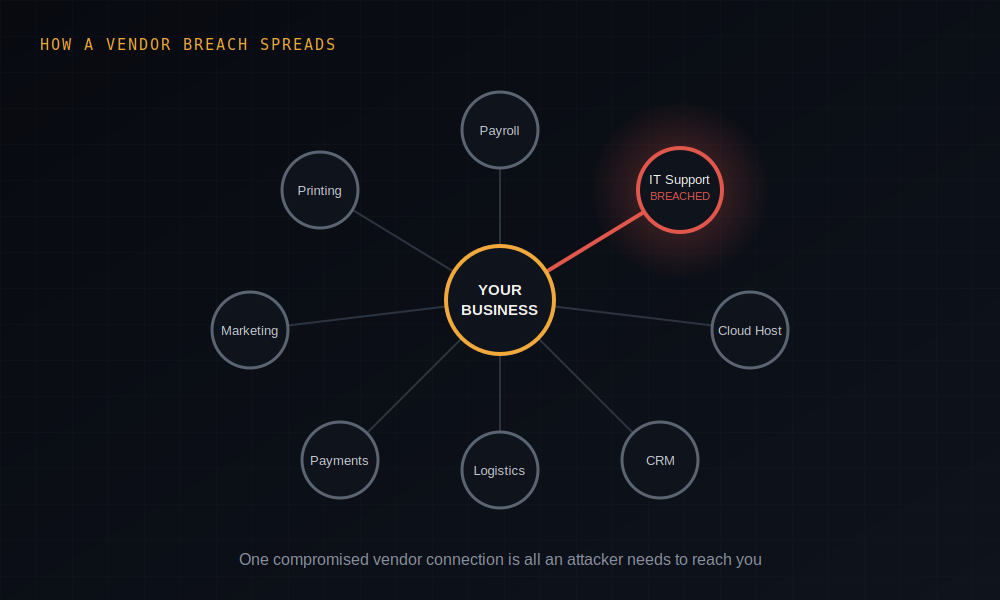
Picture your business as a chain of trusted connections. Your payroll processor. Your cloud hosting provider. Your CRM vendor. Your IT support contractor. Each one holds a piece of access. A breach does not need to hit you directly. It needs to hit the weakest link in that chain, and then move sideways using the access that link already had.
04 The Numbers Every Business Owner Should See
Recent industry research paints a consistent picture across regions, including markets like Pakistan where digital vendor networks are expanding fast:
- Third party and supply chain compromise is now the second most common cause of data breaches, and the second costliest, averaging close to five million dollars per incident.
- Ransomware groups increasingly favor vendor access over direct attacks, with over four in ten ransomware incidents now starting through a third party.
- Most organizations only formally assess a fraction of their vendors, mainly because vendor risk teams are chronically understaffed.
- Vendors typically detect a compromise within about ten days, but disclosure to affected customers now takes nearly four months on average.
Why this matters more in Pakistan
Local businesses are digitizing vendor relationships faster than they are securing them. Payment gateways, freight and logistics platforms, cloud accounting tools, and outsourced IT support are now standard, but formal vendor security assessments are still rare outside large enterprises and banks. That gap is exactly where attackers are looking. Book a Free Security Assessment
05 Real Vendor Breaches and What They Actually Cost
The Chain IQ breach mentioned earlier eventually touched at least 19 client organizations. Separately, breaches tracing back to shared retail and grocery vendors disrupted checkout systems for major chains and exposed millions of customer and staff records combined. None of the affected companies were hacked directly. Their vendors were.
The financial pattern is consistent. Breaches that originate with a third party now cost close to five million dollars on average to remediate, and take longer to contain than breaches that start inside a company’s own network, because logs, evidence, and root cause often sit with the vendor, not the victim.
06 Which Vendors Carry the Most Risk
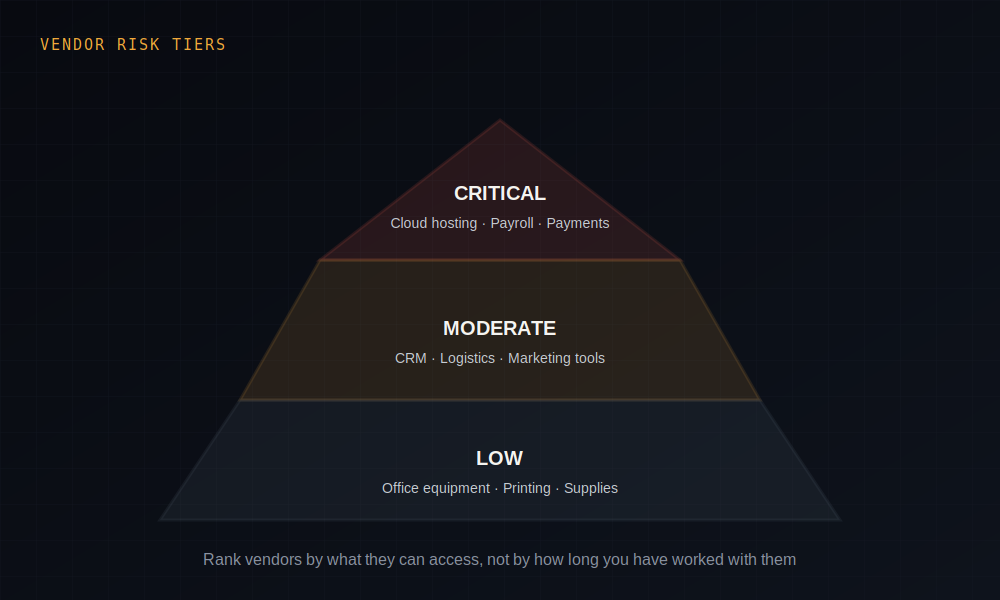
Not every vendor is equally dangerous. Risk depends on what access they hold and how deeply they connect into your systems.
| Vendor type | Typical access | Risk level |
|---|---|---|
| Cloud hosting and IT support | Full infrastructure access | Critical |
| Payroll and HR platforms | Employee financial and personal data | Critical |
| Payment processors and gateways | Customer financial data | Critical |
| CRM and marketing tools | Customer contact and behavior data | Moderate |
| Logistics and courier platforms | Customer names and addresses | Moderate |
| Office equipment and printing vendors | Limited network access | Low |
07 Warning Signs Your Vendor Ecosystem Is Already Exposed
- You cannot produce a full list of every vendor with access to your systems or data
- Vendor contracts do not mention security requirements or breach notification timelines
- Employees connect new SaaS tools without IT or security review
- You have never asked a vendor for proof of their own security controls
- Vendor access is never revoked after a project ends or a contract expires
- Nobody owns vendor risk as a formal responsibility inside your business
08 Why Strong Internal Security Is Not Enough on Its Own
Many business owners assume that if their own network is locked down, their data is safe. Third party incidents keep disproving that assumption. A vendor’s overprivileged API access, an employee at that vendor uploading sensitive files to an unauthorized tool, or a compromised support system, can expose your customer data even when your own firewalls, endpoint protection, and staff training are excellent.
Security today has to extend past your own perimeter and into every connection your business depends on.
09 The Hidden Cost of a Third Party Breach
The direct remediation cost is only part of the bill. A vendor breach also brings regulatory exposure if customer or employee data is involved, legal liability if contracts did not clearly assign responsibility, reputational damage that outlasts the technical fix, and lost time as your team investigates an incident that happened inside a system you do not control.
Because logs and root cause evidence usually sit with the vendor, businesses often cannot even confirm the full scope of what was exposed until the vendor chooses to share it, sometimes months later.
Not sure which of your vendors could sink your business tomorrow? Ambsan’s assessment team maps every vendor connection into your environment and ranks them by real risk, not guesswork.
Talk to Our Security Team
10 What SECP, State Bank, and PECA Expect From Vendor Oversight
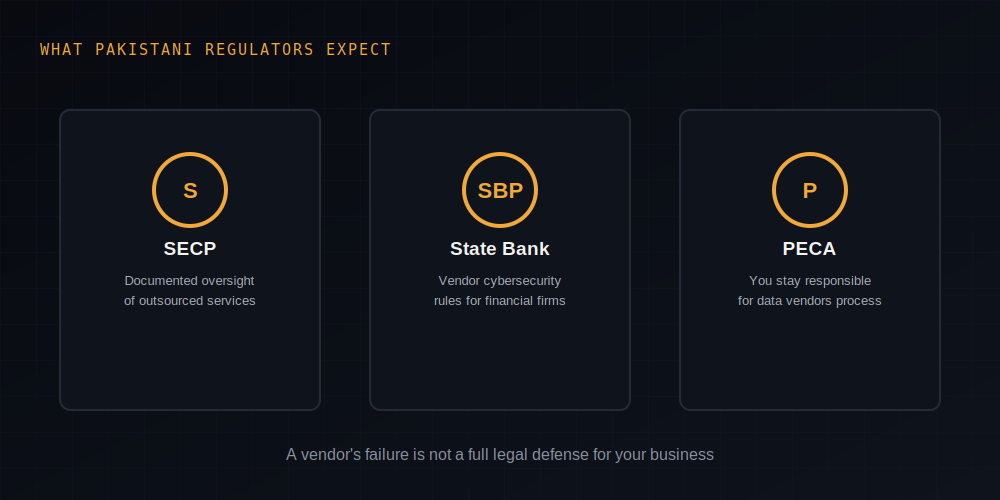
Regulatory pressure in Pakistan is catching up to this risk. SECP guidance for listed and regulated entities increasingly expects documented oversight of outsourced services. State Bank of Pakistan cybersecurity requirements for financial institutions extend explicitly to third party service providers, not just internal systems. PECA places responsibility on businesses for the data they process, regardless of which vendor is technically holding it.
In practice, this means a business cannot point to a vendor’s failure as a full defense. If customer data was exposed, the regulator’s first question is what oversight was in place before the breach happened.
11 Building a Vendor Risk Checklist That Actually Works
Before you sign or renew any vendor contract
- Vendor has provided evidence of a recent security assessment or certification
- Contract specifies a breach notification timeline, not just “as soon as possible”
- Access granted matches only what the vendor actually needs, nothing broader
- A named person inside your business owns this vendor relationship
- Access is set to expire automatically when the contract ends
12 Questions to Ask Every Vendor Before You Sign
- Who at your company can access our data, and how is that access controlled?
- Do you undergo independent security audits, and can we see a summary?
- What is your commitment window for notifying us of a breach?
- Do you use subcontractors who would also touch our data?
- What happens to our data and access the day our contract ends?
13 How Often You Should Reassess Vendor Risk
Vendor risk is not a one time checkbox. Critical vendors, the ones touching financial systems, customer data, or core infrastructure, should be reassessed at least annually and whenever their access scope changes. Lower risk vendors can be reviewed every two years. Any vendor that experiences a breach, even one that did not touch your business, should trigger an immediate review.
14 Mistakes Pakistani Businesses Keep Making With Vendor Security
The same gaps show up across industries. Vendor contracts get signed by procurement or finance teams without any security review. Access is granted broadly because it is faster than scoping it properly. Nobody revisits vendor access after the original project ends. And security is treated as the vendor’s problem to solve, not a shared responsibility.
Ambsan’s assessment engagements consistently find forgotten vendor accounts still holding live access years after a contract ended. That is not a technology gap. It is a process gap, and it is fixable.
15 How Ambsan Technologies Helps You Close the Gap
Ambsan Technologies works with businesses across Pakistan, from Karachi to Lahore to Islamabad, and with clients in the United States through our Huntington Beach office, to bring vendor risk under control before it becomes an incident. Our approach combines ISO 27001 aligned assessments, 24/7 SOC monitoring that watches for unusual activity coming through vendor connections, and practical vendor risk frameworks built around SECP, State Bank, and PECA expectations.
We do not hand you a generic checklist and walk away. We map your actual vendor ecosystem, rank the connections that matter, and help you build contract language, access controls, and monitoring that hold up under real scrutiny.
16 Industries Most Exposed to Vendor Risk in Pakistan
Banks and financial institutions face the tightest regulatory scrutiny and the highest stakes, since a vendor breach touching customer financial data triggers immediate State Bank attention. Manufacturers running OT and IoT systems increasingly depend on external vendors for equipment monitoring and maintenance, each connection a potential entry point. Textile exporters, handling international buyer data and connected to global supply chains, are attractive targets precisely because a single exporter breach can expose data belonging to multiple international brands at once.
17 Building a Vendor Risk Program That Actually Holds Up
A working program has four parts. A complete inventory of every vendor with system or data access. A risk tier assigned to each one based on what they can reach. Contract language that assigns clear security and notification responsibilities. And a recurring review cycle that does not depend on someone remembering to do it.
None of this requires a massive security team. It requires a clear starting inventory and a partner who can maintain the monitoring and review cycle for you.
Where most businesses actually start
Most businesses we work with do not begin with a full program. They begin with a single question: which of our vendors, if breached tomorrow, would actually hurt us. That is exactly what an Ambsan risk assessment answers first. Schedule a Consultation
Frequently Asked Questions
What is third party vendor risk in simple terms?
It is the security exposure your business carries because of the outside companies you work with. If a vendor with access to your systems or data gets breached, that risk becomes your risk too, even though the attack never touched your own network directly. How common are third party breaches now?
Very common. Industry research shows third party involvement in breaches roughly doubled in a single recent year, making it one of the fastest growing attack patterns businesses face today. Can my business be held responsible for a vendor’s breach?
Often, yes. Under frameworks like PECA and State Bank cybersecurity requirements, businesses in Pakistan are generally still responsible for data they process, even when a vendor was technically holding it at the time of the breach.
What is the difference between vendor risk and supply chain risk?
Vendor risk usually refers to any third party with access to your systems or data. Supply chain risk is a related term that often focuses more specifically on software providers, open source components, and the update pipelines your systems rely on.
How do I know which vendors are highest risk?
Rank vendors by what they can access, not by how long you have worked with them. A vendor touching financial systems, customer data, or core infrastructure is high risk regardless of how small or familiar the relationship feels.
Should small and medium businesses in Pakistan worry about this too?
Yes. Attackers often prefer smaller vendors precisely because they have weaker defenses but still hold access into larger client systems. Size does not reduce vendor risk, it sometimes increases how attractive you are as an entry point.
What should a vendor security clause in a contract include?
At minimum, a defined breach notification timeline, a requirement for the vendor to maintain reasonable security controls, the right to request audit evidence, and clear terms for revoking access once the contract ends.
How long does it typically take to discover a vendor breach?
Vendors often detect a compromise within about ten days internally, but public or customer disclosure frequently takes several months, which is why proactive monitoring on your side matters as much as trusting the vendor to inform you.
How can Ambsan help with vendor risk specifically?
Ambsan runs vendor risk assessments, sets up monitoring that flags unusual activity coming through third party connections, and helps build contract and review processes aligned with SECP, State Bank, and PECA expectations.
Final Thoughts
Your own defenses can be excellent and you can still get breached through a vendor you barely think about. Third party involvement in breaches has roughly doubled in a single year, and a single vendor incident now creates an average of over five downstream victims. The businesses that avoid becoming one of those victims are the ones that treat vendor oversight as an ongoing process, not a one time checkbox during procurement.
Start with an inventory. Rank your vendors by what they can actually reach. Put security terms in every contract. Review it on a schedule. That is the difference between finding out about a vendor breach from the vendor, and finding out from a customer.
Related reading
7 Warning Signs Your Business Has Already Been Breached
AI Powered Phishing in Pakistan: The New Threat Businesses Aren’t Ready For