
A customer calls to ask why they got a strange email from your company. A bank flags a transaction nobody in your finance team recognizes. A vendor mentions an invoice that was never actually sent. This is how most businesses in Karachi, Lahore, and Islamabad find out they have been breached, not from an internal alert, but from someone outside the company noticing first.
By the time that call comes in, the attacker has usually been inside the network for weeks, sometimes months. They have had time to look around, collect credentials, and quietly move data out. The warning signs were almost always there. Most IT teams simply were not watching for them, or did not have the tools in place to catch them early.
This is not a gap unique to any one industry. It shows up in manufacturing firms, banks, textile exporters, and small software houses alike. The businesses that recover fastest are the ones that know what to look for and act the moment something feels off.
Below are seven signs your systems may already be compromised, why Pakistani businesses tend to miss them, and what to do the moment you spot one.
Why Breach Detection Takes So Long in Pakistan
Large enterprises with dedicated security operations centers tend to catch intrusions within days. Small and mid sized businesses without that kind of coverage often go far longer without noticing anything wrong. Many Pakistani SMEs run IT as a support function rather than a monitored, defended system, which means logs go unreviewed, alerts go unread, and unusual activity blends into the noise of daily operations.
The result is a widening gap between when an attacker gets in and when the business finds out. Every extra week of that gap gives the attacker more time to cause damage and makes recovery more expensive.
Sign 1: Unusual Login Activity and Access Patterns
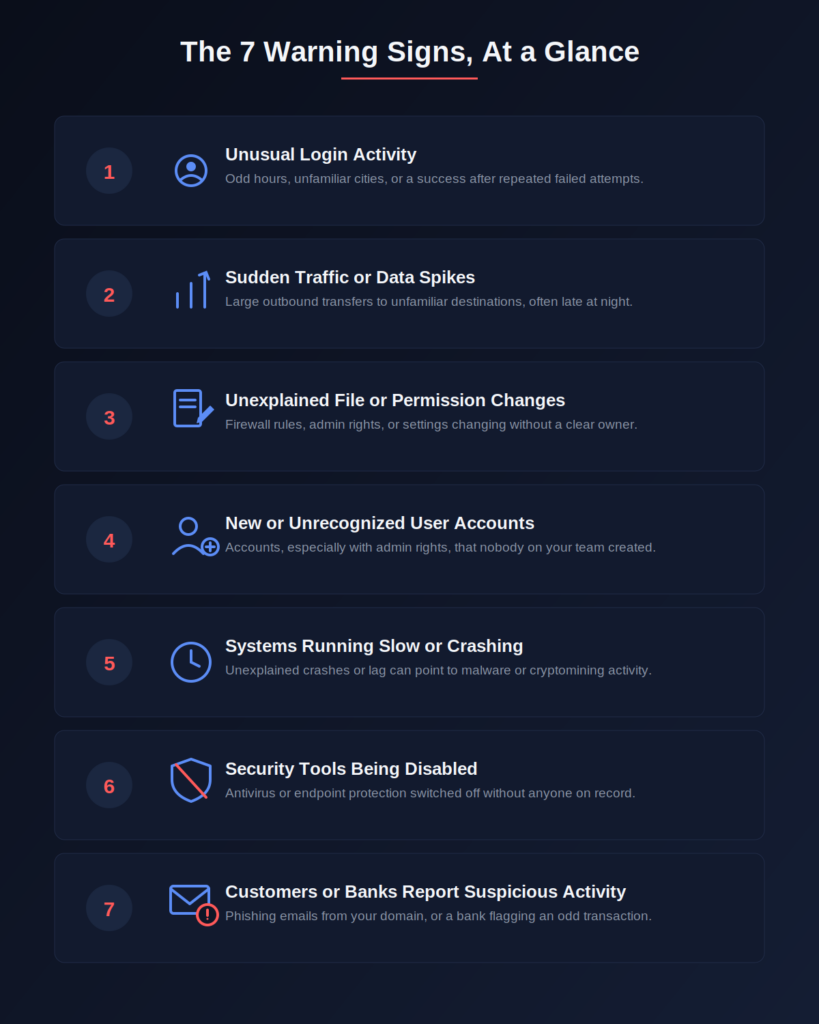
Logins at 3am from an account that only works 9 to 5. A successful login from a city your employee has never traveled to. A string of failed password attempts followed by one that succeeds. These patterns are some of the earliest and clearest indicators of a compromised account, and they are also some of the easiest to miss without centralized monitoring.
If your team is not reviewing login logs regularly, or does not have alerts set up for logins from new locations or devices, this sign can sit unnoticed for a long time.
Sign 2: Sudden Spikes in Network Traffic or Data Transfers
A spike in outbound traffic, especially late at night or to an unfamiliar destination, often means data is being copied out of your network. Attackers rarely smash and grab. They quietly package up files and move them out over time to avoid tripping alarms.
Watch for large data transfers to cloud storage services your business does not use, or traffic to IP addresses and countries with no business reason to be involved.
Sign 3: Files, Configurations, or Permissions Changing Without Explanation
Firewall rules that quietly change. Admin rights granted to an account that should not have them. Security software settings reverted without anyone touching them. These changes usually mean an attacker already has a foothold and is adjusting your systems to make their next move easier.
Sign 4: New or Unrecognized User Accounts
One of the most common things attackers do after gaining access is create a new account for themselves, often with admin privileges, so they can get back in even if the original entry point is closed. If nobody on your team can explain why an account exists, treat it as a red flag until proven otherwise.
Sign 5: Systems Running Slow, Crashing, or Behaving Strangely
Not every slowdown is a security issue, but unexplained crashes, spinning fans on idle machines, or programs opening and closing on their own can point to malware or cryptomining software running in the background. These symptoms are often dismissed as ordinary IT problems and never investigated further.
Sign 6: Antivirus or Security Tools Being Disabled
If your antivirus, endpoint detection tool, or firewall gets disabled and nobody on your team did it, that is rarely a coincidence. Disabling defenses is a standard step attackers take once they are inside, specifically so they can operate without being caught.
Sign 7: Customers, Vendors, or Banks Report Suspicious Activity Linked to You
Customers receiving phishing emails that appear to come from your domain. A vendor referencing an invoice your finance team never sent. Your bank flagging a transaction pattern that does not match your usual activity. When people outside your company start noticing something is wrong before you do, a breach has likely already been underway for some time.
Breach Warning Sign Checklist
Use this as a quick reference for your IT team. If more than one of these signs shows up at the same time, treat it as a possible active breach rather than isolated incidents.
| Warning Sign | What It Usually Means | Immediate Action |
| Unusual login activity | Credential theft or account takeover | Force password reset, enable MFA |
| Traffic or data spikes | Data exfiltration in progress | Isolate affected systems, review firewall logs |
| Unexplained file or permission changes | Attacker moving through your network | Lock down admin accounts, audit access logs |
| New or unknown user accounts | Persistence mechanism set up by attacker | Disable the account, investigate creation source |
| Slow systems or repeated crashes | Malware or cryptomining activity | Run endpoint scans, check running processes |
| Security tools disabled | Active attempt to blind your defenses | Re enable tools, escalate to your security team |
| Customers or banks report suspicious activity | Breach may already be affecting others | Notify stakeholders, begin formal investigation |
The Real Cost of a Delayed Breach Response in Pakistan
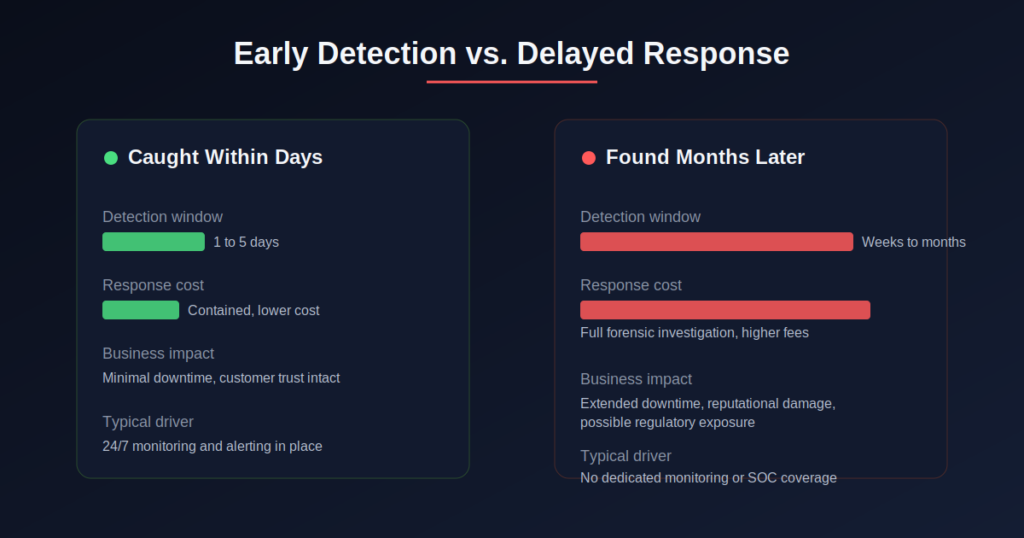
The longer a breach goes undetected, the more expensive it becomes. Costs typically fall into three buckets: direct financial loss from fraud or ransom demands, operational downtime while systems are restored, and reputational damage that affects customer trust long after systems are back online. Incident response engagements in Pakistan commonly range from a few hundred thousand rupees for a contained, early stage incident to significantly more for a business that discovers the breach months after the fact and needs full forensic investigation.
Businesses that catch and contain a breach within the first few days almost always spend a fraction of what a delayed response costs, both in direct fees and in lost business.
PECA, SECP, and Your Legal Obligations After a Breach
Pakistan’s Prevention of Electronic Crimes Act (PECA) 2016 creates legal exposure for businesses that mishandle sensitive data or fail to secure their systems appropriately. Listed companies and regulated entities also face SECP expectations around risk management and disclosure, and financial institutions have additional State Bank of Pakistan cybersecurity requirements to meet.
If your business is unsure where it stands on these obligations, it is worth reviewing them alongside your incident response plan through our Assessment and Auditing service before an incident forces the conversation.
What to Do in the First 24 Hours After You Suspect a Breach
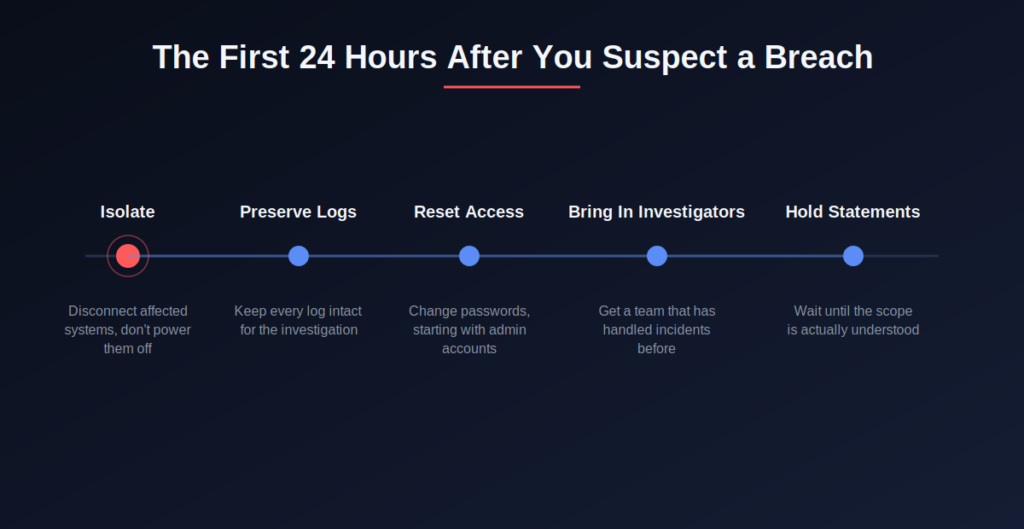
Isolate affected systems from the network without shutting them down completely, since powering off machines can destroy evidence needed for investigation. Preserve logs rather than clearing them. Change passwords for critical accounts, starting with anything with administrative access. Bring in a team that can investigate properly rather than guessing at the scope of the problem. Avoid making public statements before you understand what actually happened.
This is the point where most businesses benefit from a Threat Detection and Response team that has handled incidents before and knows how to move quickly without making the situation worse.
Common Mistakes Businesses Make After Discovering a Breach
Restoring from backup immediately, before understanding how the attacker got in, often means restoring the same vulnerability right along with your data. Wiping logs to clean things up destroys the evidence needed to understand what was accessed. Delaying notification to customers, partners, or regulators can turn a manageable incident into a compliance problem. And treating the breach as resolved once systems are back online, without closing the entry point, frequently leads to a second incident within months.
How Ambsan Technologies Detects Breaches Before They Escalate
Ambsan Technologies runs 24/7 SOC monitoring and ISO 27001 aligned assessments for businesses across Pakistan, with a presence in Karachi, Lahore, and Islamabad, as well as clients in the United States through our Huntington Beach, California office. Our team watches for the exact patterns covered in this guide, unusual logins, abnormal traffic, and configuration changes, so they get flagged in hours rather than discovered months later by a customer or a bank.
Our Network Security and Identity and Access Management services work together to close the gaps attackers rely on to stay hidden.
Building a Breach Detection and Response Plan With Ambsan
A solid detection and response plan starts with an honest assessment of where your current gaps are, followed by monitoring coverage for the systems that matter most, a documented response process your team can follow under pressure, and periodic tabletop exercises so the plan holds up when it is actually needed.
If your business handles sensitive customer data, financial transactions, or connects to industrial systems, our Application Security and OT and IoT Security teams can help close those gaps as part of the same plan.
Book a Free Security Assessment with our team to find out where your business stands today.
Frequently Asked Questions
How long does it take businesses to detect a breach?
Businesses without dedicated monitoring often take weeks or months to detect a breach. Organizations with 24/7 SOC coverage typically catch and contain intrusions within days.
What is usually the first sign of a data breach?
Unusual login activity is one of the earliest signs, particularly logins from unfamiliar locations, odd hours, or repeated failed attempts followed by a successful one.
Can a business be breached without knowing it?
Yes. Many breaches go unnoticed for weeks or months because attackers deliberately avoid triggering obvious alarms while they collect data or move through the network.
Is PECA compliance mandatory for all Pakistani businesses?
PECA applies broadly to electronic crimes and data handling in Pakistan, and businesses that process sensitive customer data carry real legal exposure if that data is mishandled. Regulated sectors face additional SECP or State Bank requirements on top of PECA.
What should I do first if I suspect a breach?
Isolate the affected systems without powering them off, preserve your logs, change critical passwords, and bring in a team that can investigate the scope before you make any public statements.
Do small businesses in Pakistan actually get targeted by hackers?
Yes. Small and mid sized businesses are frequently targeted precisely because they tend to have weaker monitoring and slower detection than larger enterprises, making them easier targets.
How much does incident response cost in Pakistan?
Costs vary widely depending on how early the breach is caught. Contained, early stage incidents typically cost far less than breaches discovered months later that require full forensic investigation and recovery work.
What is the difference between a data breach and a cyber attack?
A cyber attack is any attempt to compromise a system, while a data breach specifically refers to unauthorized access or exposure of sensitive data. Not every attack results in a breach, but every breach starts with some form of attack.
Should we shut down our systems immediately after finding a breach?
Not necessarily. Powering off systems can destroy evidence needed for investigation. Isolating affected systems from the network while keeping them running is usually the safer first step.
How can Ambsan help after a breach?
Ambsan Technologies provides incident investigation, 24/7 SOC monitoring, and post breach hardening across network, application, and identity security, so businesses can contain the immediate incident and reduce the chance of a repeat.
Final Thoughts
Most breaches are not sudden. They leave a trail, unusual logins, strange traffic, accounts nobody remembers creating, tools quietly switched off. The businesses that catch these signs early spend a fraction of what a delayed response costs, and they keep the trust of the customers and partners who depend on them.
Our Related Blogs:
Ransomware-as-a-Service: How Anyone Can Now Launch a Cyberattack.
Ransomware Defense: How to Detect, Isolate and Recover Fast
If any of the seven signs above sound familiar, do not wait for a customer or a bank to tell you next. Talk to Our Security Team today.