
Seventeen DDoS attacks hit Pakistani organizations in the first months of 2026 alone. Here is what is driving the spike, who is being targeted, and what an actual defense looks like.
A Karachi based fintech goes offline for six hours during peak transaction time. No data is stolen. No ransom note appears. The website simply drowns under traffic that was never meant to be handled, and by the time the team figures out what happened, customers have already moved to a competitor’s app.
That is a DDoS attack, and it does not need to breach a single system to cause serious damage. It just needs to make your network unavailable at the worst possible moment.
In the first months of 2026, Pakistan recorded 98 cyberattacks against government and private entities, according to national cybersecurity monitoring data. Seventeen of those were distributed denial of service attacks, second only to website hacking as the most common attack type. Twenty one federal institutions were affected. This is no longer a fringe threat that only global enterprises worry about. It is showing up in local incident reports, month after month.
This guide breaks down what a DDoS attack actually is, why 2026 has seen such a sharp rise, which industries in Pakistan are most exposed, and what a network security setup that can actually absorb an attack looks like.
17 DDoS attacks reported in Pakistan in early 2026 alone
121% Year over year rise in DDoS attacks recorded globally by Cloudflare in 2025
34% Share of global network layer DDoS attacks aimed at financial services
01 What Is a DDoS Attack, in Plain English
A distributed denial of service attack floods your network, server, or application with more traffic than it can handle. Think of a shop with one entrance suddenly facing ten thousand people trying to walk in at once. Real customers cannot get through. Nothing is stolen. Nothing is technically broken. The system just stops responding.
The word distributed matters. Attackers rarely send this traffic from one machine. They use networks of hijacked devices, routers, cameras, and even smart home gadgets, called botnets, to fire traffic from thousands of sources at the same time. That makes DDoS attacks hard to block with a simple IP ban, because the traffic is not coming from one place.
02 DDoS Attacks in Pakistan: What the 2026 Numbers Actually Show
Pakistan’s early 2026 cybersecurity incident data paints a clear picture. Out of 98 recorded attacks, website hacking led at 42 cases, but DDoS attacks tied with data leaks at 17 cases each, well ahead of phishing campaigns. Sixteen incidents hit business organizations directly, and 13 targeted educational institutions. Only two attacks caused a complete website shutdown, which tells you something important: most DDoS attacks do not need to fully take a system down to cause damage. Degraded performance for a few hours during business hours is often enough.
The telecom, health, power, and media sectors each reported multiple incidents in the same window, a spread that matches what regional and global reports have been seeing since 2025.
Why this matters
If your business runs on a website, an app, a payment gateway, or a customer portal, a DDoS attack does not need to steal anything to hurt you. It just needs to keep real customers out for long enough.
03 Why DDoS Attacks Are Different From Other Cyber Threats
Most cybersecurity conversations in Pakistan center on ransomware, phishing, and data breaches, and for good reason. But DDoS attacks play by different rules.
- No system compromise needed. Attackers do not need to get inside your network. They only need to overwhelm it from outside.
- Impact is immediate. A ransomware attack can sit undetected for weeks. A DDoS attack takes your services down within minutes.
- Low cost, low skill. DDoS for hire services on underground platforms can be rented for a small monthly fee, putting this attack within reach of almost anyone with a grudge or a competitor’s budget.
- Often used as a smokescreen. Some attackers launch a DDoS flood to distract security teams while a separate, quieter intrusion happens elsewhere in the network.
04 The Three Main Types of DDoS Attacks Businesses Face
Not all DDoS attacks look the same, and your network security strategy needs to account for all three categories.
Volumetric attacks
These attacks aim to consume all available bandwidth by flooding your network with junk traffic. The global record in 2025 hit 31.4 terabits per second in a single burst, lasting only 35 seconds but enough to overwhelm most standard defenses instantly.
Protocol attacks
These target weaknesses in network protocols themselves, exhausting server resources or the capacity of firewalls and load balancers rather than raw bandwidth. SYN floods are the most common example.
Application layer attacks
These are quieter and harder to spot. They mimic normal user behavior, sending seemingly legitimate requests to a website or app until the server buckles under the load. Most of these attacks are actually smaller in size but designed to slip past detection thresholds, which is exactly what makes them dangerous.VOLUMETRIC PROTOCOL APPLICATION LAYER Floods bandwidth Exhausts server handshakes Mimics real users, slips past filters The three DDoS attack categories target different layers of your network, which is why single point defenses fail.
05 Why DDoS Attacks Are Getting Bigger and More Frequent Worldwide
Three forces are driving the surge behind these numbers.
- IoT botnets keep growing. Every unsecured smart camera, router, and connected device is a potential foot soldier in an attacker’s botnet, and the number of poorly secured IoT devices online keeps climbing.
- DDoS for hire has commoditized the attack. Stress testing services advertised openly on messaging platforms let anyone rent an attack for a low monthly fee, no technical skill required.
- Geopolitical tension spills into cyberspace. Regional conflicts have repeatedly triggered coordinated hacktivist DDoS campaigns against government, financial, and telecom targets, and South Asia has not been an exception.
Not sure how exposed your current setup is? Book a free security assessment and Ambsan’s team will map your network’s actual DDoS exposure in under a week.
06 Which Pakistani Industries Are Most at Risk
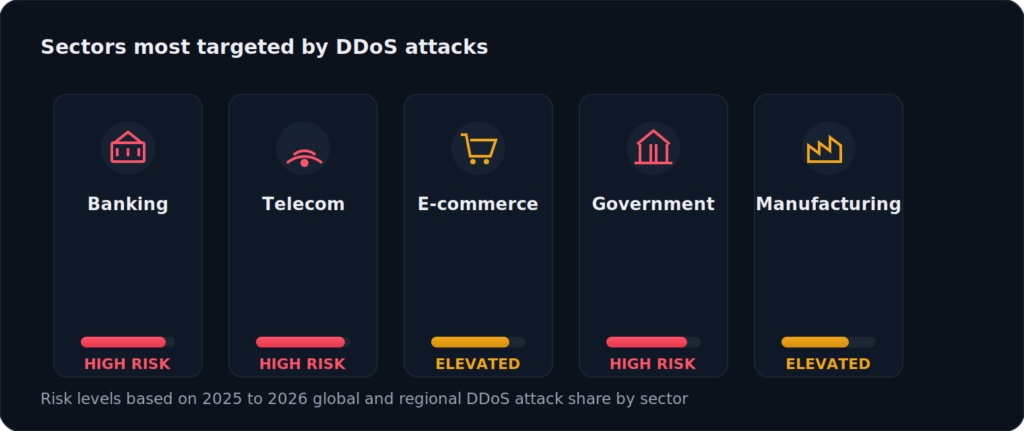
Global attack data lines up closely with what local incident reports are showing.
- Banking and financial services. Financial services accounted for roughly a third of global network layer DDoS attacks last year, and the region saw one of the sharpest year over year increases anywhere in the world.
- Telecommunications and ISPs. Telecom providers became the single most attacked industry globally by the end of 2025, and Pakistan’s own incident data shows telecom among the repeat targets in 2026.
- E-commerce and retail platforms. Online stores see the highest volume of application layer DDoS activity of any sector, because even short outages during a sale or peak hour directly cost revenue.
- Government and public sector bodies. Hacktivist groups treat government services as a preferred target, and federal institutions made up a large share of Pakistan’s reported 2026 incidents.
- Manufacturing and industrial operators. Manufacturing networks tend to face the largest average attack sizes of any sector, often because operational technology systems were never designed with modern network security in mind.
07 What a DDoS Attack Actually Costs Your Business
The financial hit from a DDoS attack rarely shows up as a single line item, which is why boards tend to underestimate it. It shows up as lost transactions during downtime, support staff overtime, emergency vendor fees, refunds and SLA penalties, and the harder to quantify cost of customers who quietly switch to a competitor after one bad experience. For a bank or e-commerce platform, even 30 minutes of downtime during peak hours can outweigh a full year of network security investment.
| Attack duration | Typical business impact |
|---|---|
| Under 15 minutes | Minor disruption, some transaction failures, support tickets spike |
| 15 minutes to 2 hours | Lost sales or transactions, SLA breaches, customer complaints on social media |
| Over 2 hours | Reputation damage, regulatory scrutiny for regulated sectors, customer churn |
08 Warning Signs Your Network Is Under a DDoS Attack Right Now
- Website or app becomes slow or unreachable with no recent code deployment or change
- Unusual spike in traffic from a narrow range of IP addresses or countries you do not normally serve
- Server or firewall CPU usage spikes without a matching rise in legitimate user activity
- Customer complaints about timeouts, error pages, or failed transactions arriving in a short window
- Network monitoring tools show a sudden, sustained rise in requests per second
09 Why Your Existing Firewall Will Not Stop a DDoS Attack
This is the single biggest misconception Ambsan’s team hears from Pakistani IT managers. A traditional firewall is built to control what traffic is allowed in and out based on rules. It was never built to absorb millions of simultaneous connection attempts. Once attack traffic reaches the firewall, the firewall itself often becomes the bottleneck that fails first, taking the rest of the network down with it.
DDoS protection is not a feature you add to a firewall. It is a separate layer of network security, usually working upstream of your firewall, that filters and absorbs malicious traffic before it ever reaches your infrastructure.
10 Network Security vs DDoS Protection: What Is the Difference
Network security is the umbrella. It includes firewalls, intrusion detection, segmentation, access control, and monitoring, all working together to protect what happens inside and around your network. DDoS protection is one specific piece of that umbrella, focused entirely on keeping malicious traffic from overwhelming your systems in the first place. A business can have solid network security in every other sense and still go offline during a DDoS attack, simply because that one layer was never built out.
Find out where your network actually stands
Ambsan’s security team reviews your current firewall setup, traffic patterns, and DDoS exposure, then hands you a clear, no jargon report.
Book a Free Security Assessment
Explore Network Security Solutions
11 Building a DDoS Resilient Network Security Architecture
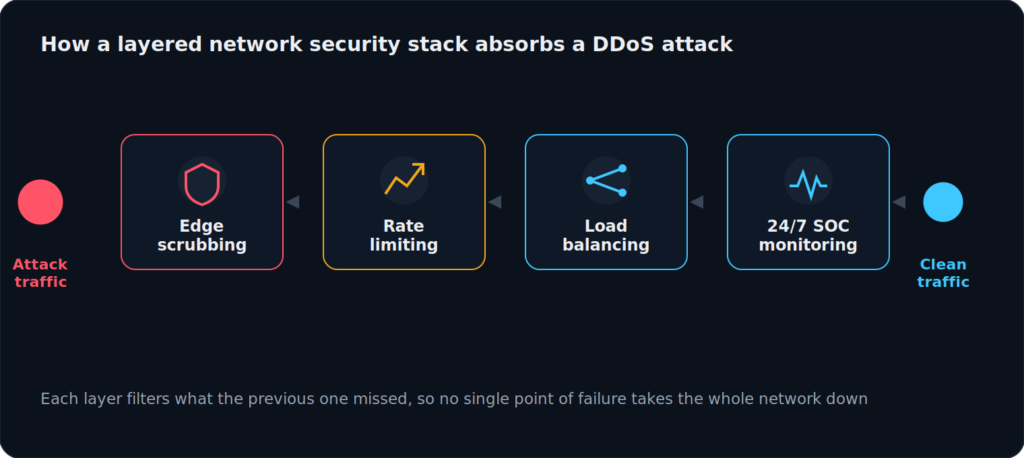
A network that can absorb a DDoS attack without going dark is built in layers, not with a single tool.
- Traffic scrubbing at the edge. Malicious traffic gets filtered before it reaches your servers, often through a specialized upstream provider.
- Rate limiting and traffic shaping. Rules that cap how many requests a single source can send in a given window, slowing down floods without blocking real users.
- Load balancing across multiple servers. Spreading traffic reduces the chance that one overwhelmed server takes the whole service down.
- Real time traffic monitoring. Round the clock visibility so unusual spikes get caught in minutes, not hours.
- A tested incident response plan. Knowing exactly who does what in the first 15 minutes of an attack, instead of figuring it out live.
12 Cloud Based DDoS Protection vs On Premise Appliances
Cloud based DDoS protection routes your traffic through a provider’s global network before it reaches you, absorbing large volumetric attacks far away from your infrastructure. It scales automatically and is usually the more practical choice for most Pakistani SMEs and mid sized enterprises, since it does not require large upfront hardware spend.
On premise appliances give you more direct control and can be useful for organizations with strict data residency requirements, such as banks and government bodies, but they have a hard capacity ceiling. Once attack traffic exceeds what the appliance can handle, it fails the same way a firewall does. Many mature setups in Pakistan now combine both, a cloud layer for scale and an on premise layer for control.
13 DDoS Mitigation Checklist Every Pakistani Business Should Follow
- Map your critical services and know exactly what downtime would cost per hour
- Deploy DDoS protection upstream of your firewall, not as a firewall feature
- Set up real time traffic and bandwidth monitoring with alerting
- Configure rate limiting on public facing applications and APIs
- Segment your network so an attack on one service does not take everything down
- Keep IoT and connected devices on isolated network segments
- Write and test an incident response plan specific to DDoS scenarios
- Review your ISP’s DDoS response capability and escalation process in advance
- Run a network security assessment at least once a year
14 What to Do in the First 15 Minutes of a DDoS Attack
- Confirm it is actually a DDoS attack and not a code deployment issue or a legitimate traffic surge from a marketing campaign.
- Activate your incident response plan and notify the team members responsible for network, communications, and customer support.
- Engage your DDoS protection provider or ISP immediately if attack traffic exceeds what your own systems can absorb.
- Isolate non critical systems where possible to preserve capacity for the services that matter most.
- Communicate early with customers if the outage is visible, rather than letting them find out through social media complaints.
15 Why Network Security Has Become a Board Level Conversation
Ten years ago, network security was an IT budget line. In 2026, it is a business continuity question that boards and CEOs are being asked directly, especially in regulated sectors like banking, where downtime carries both financial and regulatory consequences. A DDoS attack does not care about your org chart. It takes down the systems your revenue, your customer trust, and in some cases your compliance obligations all depend on, all at once.
This is exactly why Ambsan positions network security as a business resilience conversation, not just a technical one, when working with leadership teams across Pakistan and internationally.
16 How Ambsan Approaches Network Security and DDoS Protection
Ambsan Technologies works with businesses across Pakistan, and internationally through our Ambsan USA office, to build network security that holds up under real attack conditions, not just on paper. Our approach combines 24/7 SOC monitoring, layered network defenses, and DDoS resilient architecture design, backed by a team that has supported organizations from local SMEs to large enterprises.
We do not sell a single box and call it done. We assess your actual traffic patterns and risk profile first, then design a network security setup, spanning firewall deployment, security assessment, and ongoing monitoring, that matches what your business genuinely needs to stay online.
17 What DDoS Protection Actually Costs vs What an Attack Costs
Every business owner asks this question eventually, usually after reading a story like the one at the top of this article. The honest answer is that proper DDoS protection and layered network security cost a fraction of what even a single serious outage costs a mid sized business in lost transactions, support overtime, and customer churn. Ambsan’s team can walk you through realistic numbers for your specific setup during a free assessment, rather than a generic industry estimate that may not reflect your actual risk.
Talk to Ambsan’s security team before an attacker finds your weak point
Get a clear picture of your DDoS exposure and a practical plan to close the gaps, no pressure, no jargon.
Frequently Asked Questions
What is the difference between a DDoS attack and a regular cyber attack?
A regular cyber attack usually tries to break into a system to steal data or plant malware. A DDoS attack does not try to get inside at all. It floods your network or application with traffic until real users cannot get through, aiming to disrupt rather than infiltrate.How long do DDoS attacks usually last?
Duration varies widely. Some volumetric attacks last only seconds but hit extreme traffic volumes, while application layer attacks can be sustained for hours or even days at lower, harder to detect volumes. The median attack against financial targets has been getting notably longer year over year.Can a small business in Pakistan really be a DDoS target?
Yes. DDoS for hire services are inexpensive and easy to access, which means small and mid sized businesses, not just large enterprises, are realistic targets, especially from competitors, disgruntled individuals, or opportunistic attackers.Does a firewall protect against DDoS attacks?
A standard firewall alone does not stop a DDoS attack. It is built to enforce access rules, not absorb massive volumes of simultaneous traffic. DDoS protection needs to sit upstream of the firewall as its own dedicated layer.How do I know if my business is currently under a DDoS attack?
Common signs include a sudden website or app slowdown with no recent changes on your end, unusual traffic spikes from narrow IP ranges, and a wave of customer complaints about timeouts arriving all at once. Real time monitoring is the fastest way to confirm it.What industries in Pakistan are most at risk of DDoS attacks?
Banking and financial services, telecommunications, e-commerce, government institutions, and manufacturing have all shown up repeatedly in both local incident data and global attack reports as frequent DDoS targets in 2026.Is cloud based DDoS protection better than on premise hardware?
For most Pakistani SMEs and mid sized enterprises, cloud based protection offers better scalability and lower upfront cost. Organizations with strict data residency needs, such as banks, often combine both approaches for control and scale together.How much does DDoS protection cost compared to an attack?
Costs depend on business size and risk profile, but layered network security and DDoS protection consistently cost far less than the revenue, support, and reputation losses from even a single multi hour outage. Ambsan provides tailored numbers during a free assessment.Can DDoS attacks be used to hide a bigger breach?
Yes. Some attackers launch a DDoS flood specifically to distract security teams while attempting a separate, quieter intrusion elsewhere in the network. This is one reason a DDoS incident response plan should include checking for other suspicious activity, not just restoring uptime.Who should be responsible for DDoS response in a company, IT or leadership?
Both. IT and security teams handle the technical response, but leadership needs to be looped in immediately because a DDoS attack directly affects revenue, customer trust, and in regulated sectors, compliance obligations. This is why network security has become a board level topic rather than a purely technical one.
Final Thoughts
DDoS attacks do not need to steal a single record to hurt your business. They just need thirty minutes of downtime at the wrong moment. With 17 recorded incidents in Pakistan in the first months of 2026 alone, and global attack volumes more than doubling year over year, treating network security as a background IT task is no longer realistic for any business that depends on being online.
The good news is that DDoS resilience is buildable. Layered defenses, real time monitoring, and a tested response plan can take a business from a likely six hour outage down to a manageable few minutes, if the groundwork is in place before the attack, not during it.
Related: Third Party Vendor Risk, How One Breach Sinks a Business
Related: Your Firewall Is Renewed, Your Network Isn’t Safe, Here’s Why
Ready to see where your network actually stands?
Book a free, no obligation risk assessment with Ambsan’s security team and get a clear plan, not a sales pitch.
Ambsan Technologies is a Karachi based cybersecurity firm serving businesses across Pakistan and the United States, with 24/7 SOC monitoring, network security, and managed IT services for SMEs and enterprises.