
A government entity got hacked. Then the numbers came out. In the first three months of 2026, Pakistan logged 98 cyberattacks, hitting government offices, private businesses, schools, and even the health and power sectors. That is roughly one attack every single day, and the real figure is almost certainly higher once you account for incidents that never get reported.
If you run a business in Karachi, Lahore, or Islamabad and think this data does not apply to you, look again. Sixteen of those 98 attacks hit the business sector directly. No industry, no city, and no company size was fully spared. Manufacturers, exporters, retailers, and service companies all showed up in the numbers.
This is not another scare piece about hackers in hoodies. It is a full breakdown of what the actual 2026 data shows, how it compares to the 2025 trend, why website hacking remains the single biggest threat, which sectors are most exposed, and what Pakistani business owners and IT managers should be doing differently this quarter.
We will also walk through what a typical attack actually looks like in practice, what the true cost of a breach adds up to once downtime and recovery are factored in, and how new regulatory requirements from the State Bank of Pakistan, the Pakistan Telecommunication Authority, and other regulators change what is expected of you going forward.
By the end of this article you will know exactly where the real risk sits, how regulators are responding, and what a practical, prioritized next step looks like for your organization, whether you run a ten person startup or a two hundred person enterprise.
The Numbers Nobody Is Talking About
Ninety eight cyberattacks in ninety days is not a small statistic. It works out to roughly seven to eight incidents every week across Pakistan. And this is only what got reported. Security teams and researchers widely agree that unreported incidents, especially at smaller companies that fear reputational damage more than the attack itself, push the real number much higher.
Here is how the reported attacks broke down by target:
- 32 attacks hit provincial government institutions
- 21 attacks hit federal government departments
- 16 cyberattack cases hit the business sector
- 13 incidents hit educational institutions
- 4 incidents hit the telecom sector
- 3 incidents each hit the health, power, and media sectors
- 1 incident each hit the defense and aviation sectors
Government still absorbs the largest share of attacks, at over half of all reported incidents combined. But the business and education numbers are the ones private sector leaders should sit with. These are not abstract targets. They are companies and institutions much like yours, run by people making the same budget and staffing tradeoffs you make every quarter.
How 2026 Compares to the 2025 Trend
Context matters here. Across all of 2025, Pakistan recorded 111 attacks against federal institutions and 137 against provincial governments for the full year. Compare that to the first quarter of 2026 alone, where provincial and federal government bodies already account for 53 incidents combined. Even accounting for reporting differences, the pace has not slowed down.
What this tells us is that 2026 is not a quiet correction after a bad year. It is a continuation, and in some categories an acceleration, of the same pressure Pakistani organizations were already under. Any business that treated 2025 as a one off bad stretch should revisit that assumption.
Which Sectors Got Hit Hardest, and Why It Matters to You
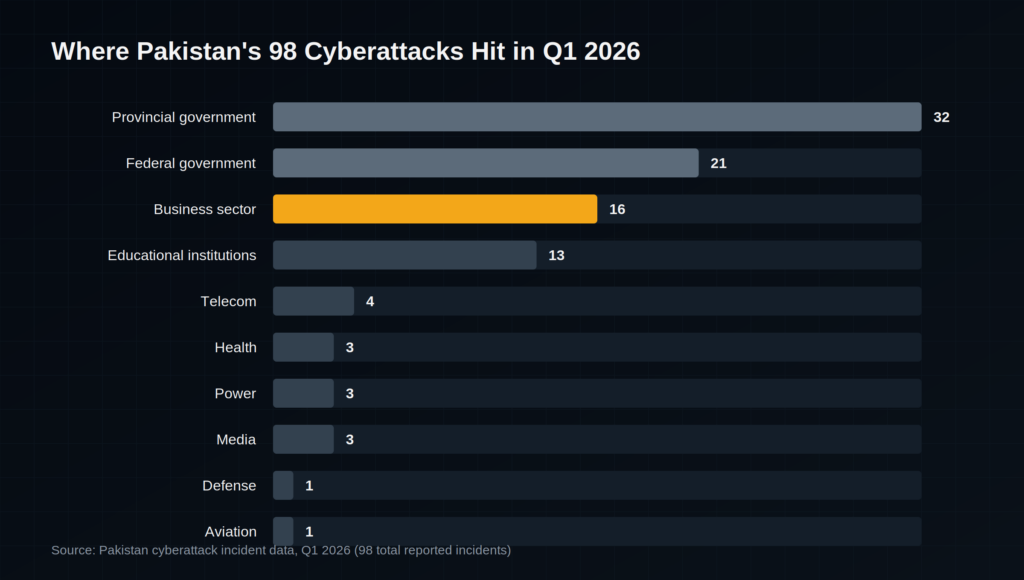
Provincial and federal government bodies together accounted for over half of all reported incidents. That tells us attackers are still finding public sector systems easier to breach than they should be. But it also tells us something else, something more useful for a private business trying to prioritize its own spending: attackers go where the defenses are weakest, not necessarily where the data is most valuable.
For a private business, that is the real lesson. If your security posture looks like a typical under resourced government department, with outdated software, shared admin credentials, and no dedicated security staff, you become just as attractive a target, regardless of your industry or your size. Attackers scanning for vulnerabilities do not check your revenue first.
Website Hacking Is Still the Number One Threat
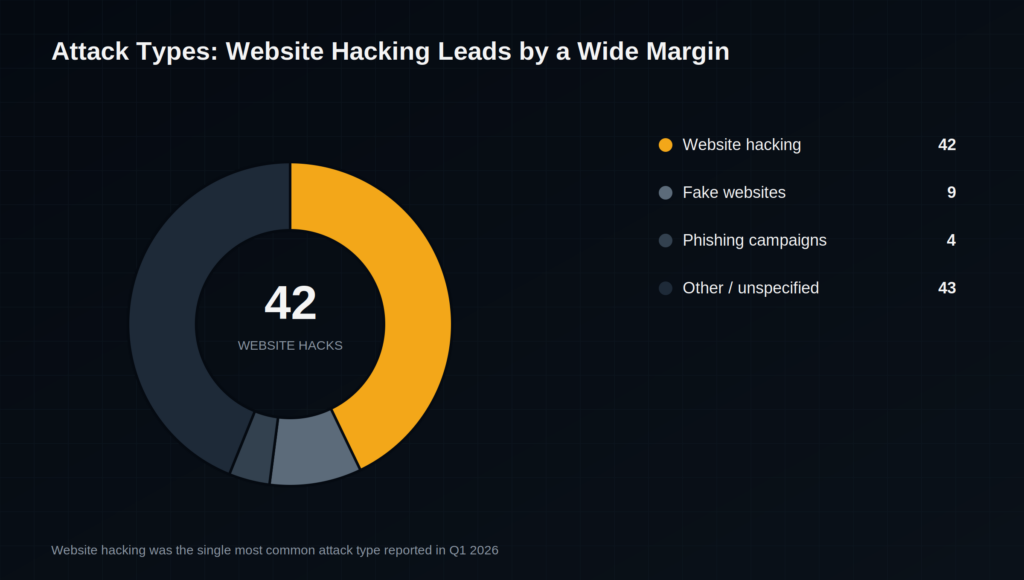
Out of all attack types recorded, website hacking was the most common, with 42 cases reported. That is more than four times the number of phishing campaigns reported in the same period, and it makes website security the single highest priority fix for most Pakistani organizations right now.
This matters because website compromises are often the easiest and cheapest attacks to prevent, and the most damaging to ignore. An outdated content management system, a weak admin password, an unpatched plugin, or a forgotten staging environment left open to the internet is often all it takes. Attackers use automated scanners that check thousands of sites a day for exactly these gaps. They are not targeting you specifically. They are targeting anyone who left the door unlocked.
What a Typical Website Hack Actually Looks Like
Most website compromises do not start with a sophisticated attacker manually probing your systems. They start with a bot that finds an outdated plugin or an exposed login page. From there, the attacker either defaces the site, injects malicious redirect code, plants malware to infect visitors, or quietly uses the server as a launch point for further attacks elsewhere. Business owners often do not notice until customers complain, search rankings drop, or the hosting provider suspends the account.
Why Provincial Government Bodies Are Such an Easy Target
Provincial institutions often run on legacy infrastructure, inconsistent patching schedules, and small or nonexistent internal security teams. Budget cycles move slowly. Staff turnover is high. Systems that were built a decade ago are still in production because replacing them is expensive and politically complicated. None of that is unique to government. Plenty of mid sized Pakistani businesses run on the exact same conditions, just without the same public scrutiny when something goes wrong.
The difference is that a breached government office makes the news, prompts a parliamentary committee review, and generates public pressure to fix the problem. A breached SME quietly absorbs the cost, pays for cleanup out of its own pocket, and rarely tells anyone outside the company. That silence is not a sign of safety. It is a sign that the real scale of the private sector problem is still mostly invisible.
The Business Sector Is Not Immune
Sixteen reported cyberattacks in three months against private businesses is not a small number, and it almost certainly understates the real figure. Many companies choose not to disclose incidents to avoid reputational damage, to protect client relationships, or simply because they are not required to under current law. Unlike listed companies in some other markets, most Pakistani SMEs face no legal obligation to publicly report a breach at all.
Retailers, manufacturers, exporters, and service companies were all represented in this wave. If your business handles customer data, payment information, or supplier systems, you are a viable target regardless of size. Textile exporters in particular, given their reliance on international buyer portals and cross border data sharing, carry a specific exposure worth a closer look on its own.
Education Institutions Are Quietly Becoming a Target
Thirteen incidents against educational institutions in one quarter is a number worth pausing on. Schools, colleges, and universities hold large volumes of personal data on students and staff, often protected by minimal security budgets and IT teams stretched across academics, administration, and infrastructure all at once. As more institutions move admissions, fee collection, and academic records online, this exposure will only grow.
Private schools and universities that operate as businesses, with tuition revenue and reputational stakes on the line, should treat this category with the same seriousness as any commercial enterprise. A breach involving student records carries both a financial and a trust cost that is difficult to reverse.
Phishing and Fake Websites: The Silent Growth Area
Beyond the headline attack types, the data recorded four phishing campaigns and nine cases involving fake websites built specifically to deceive users. These numbers look small next to the 42 website hacking cases, but they represent a different kind of risk. Phishing and fake sites do not need to break through a firewall. They only need one employee to click one link, enter one password, or approve one fraudulent invoice.
Awareness training is often treated as an afterthought, a single session during onboarding that nobody remembers six months later. Based on this data, it deserves the same budget priority as technical controls, delivered on an ongoing basis rather than as a one time checkbox exercise.
What This Data Tells Us About the State of Pakistan’s Cyber Defense
Put together, this data paints a clear picture. Pakistan is under sustained, near daily cyber pressure, and the response so far has been reactive rather than preventive. Regulators are catching up. New sectoral CERT requirements and a national push toward mandatory security operations centers are steps in the right direction, but implementation takes time, and attackers are not waiting for that implementation to finish.
At Ambsan Technologies, we track incident data like this precisely because our clients need to know if their industry, their city, or their business type has moved up the target list. Awareness is the first layer of any real defense strategy. The second layer is turning that awareness into a prioritized, budgeted action plan instead of a vague sense of concern.
Why Small and Medium Businesses Rarely Make Headlines, But Lose More
Large enterprises and government bodies get the news coverage. SMEs get the financial damage without the visibility. A smaller company often has fewer backups, no incident response plan, and no dedicated IT security staff. When something goes wrong, recovery takes longer and costs more relative to the size of the business, sometimes enough to threaten the business itself.
There is also a compounding effect. A large enterprise with a dedicated legal and PR team can absorb a breach, communicate around it, and move forward. A twenty person company that loses a week of operations to ransomware, plus its customer trust, often does not have the same runway to recover.
The Real Cost of a Breach Beyond the Headlines
A cyberattack rarely ends with the incident itself. Businesses face downtime, customer trust erosion, potential regulatory scrutiny, and the direct cost of forensic investigation and recovery. For a small or mid sized Pakistani business, a single serious breach can represent months of profit, sometimes more, once you add lost sales during downtime, staff hours spent on cleanup, and the cost of any customer notifications or credit monitoring you choose to offer.
There is also a cost that rarely makes it into any report: the deals that quietly do not happen. Enterprise clients and international buyers increasingly ask about security posture before signing contracts. A visible breach, or even a reputation for weak security within your industry, can cost you business you never even knew you lost.
The good news is that most of these attacks are preventable with the right controls in place. If you want a clear picture of where your business stands, you can book a free security assessment with our team before an incident forces the conversation.
New Regulatory Pressure: Sectoral CERTs and the SOC Deadline
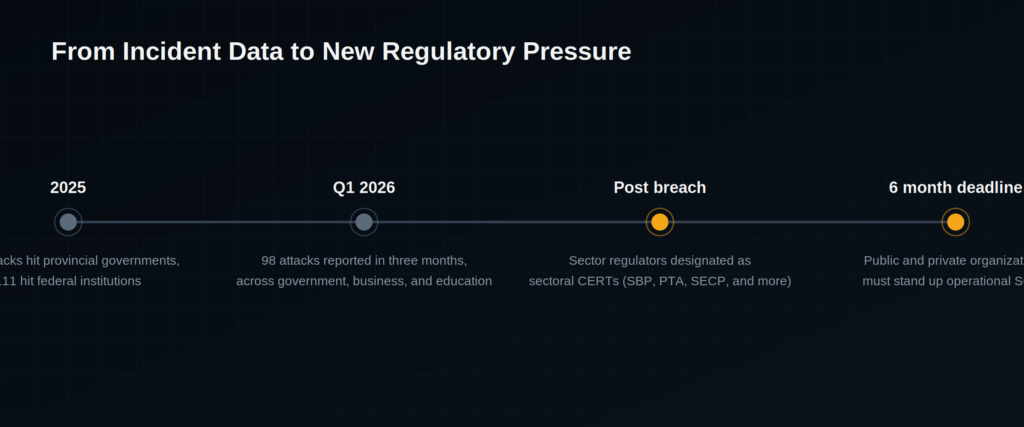
Following recent government breaches, Pakistani regulators including the State Bank of Pakistan, the Pakistan Telecommunication Authority, and the Securities and Exchange Commission of Pakistan are being formally designated as sectoral CERTs. Public and private sector organizations have also been given a firm deadline to stand up fully operational security operations centers, with the national CERT coordinating threat intelligence and response across all designated sectors.
A national Pakistan Information Security Framework is also under review, expected to introduce formal compliance and auditing controls once approved. Organizations that wait until the framework is finalized to start preparing will likely find themselves scrambling against a compressed timeline.
We covered what this timeline means in detail in our post on the new SOC deadline for Pakistani businesses. If your organization falls under any of these regulators, that deadline applies to you whether or not you have started preparing.
What the Draft Data Protection Law Could Mean for You
Pakistan does not yet have a single, unified data protection statute equivalent to frameworks used in other markets. But draft rules currently under review propose a 72 hour breach notification window for organizations that handle personal data, alongside amendments to existing electronic crimes legislation that increase penalties for unauthorized access and data misuse.
Even before this becomes binding law, it is worth treating the 72 hour standard as the practical benchmark to prepare for. If your organization could not identify, contain, and begin notifying affected parties within three days of discovering a breach today, that gap is worth closing now rather than after the law takes effect.
How Ambsan Reads This Data Differently
Raw incident counts tell you what happened. They do not tell you what to do next. Our security team uses data like the 2026 attack breakdown to prioritize where clients should focus first, whether that is website hardening, employee phishing awareness, or 24/7 monitoring for early warning signs, based on what the numbers actually show rather than what feels urgent in the moment.
This is the same approach behind our Threat Detection and Response and Assessment and Auditing services, built specifically around the threats Pakistani organizations are actually facing, not generic global checklists translated from other markets.
A Practical Checklist: Are You an Easy Target?
Ask yourself these questions honestly. If you answer no to more than two, your business likely looks like an easy target to an attacker scanning for weak points.
- Has your website had a security audit in the last 12 months?
- Do you have a documented incident response plan that someone has actually read?
- Is multi factor authentication enabled across all admin and finance accounts?
- Has your team received phishing awareness training this year, not just at onboarding?
- Are your backups tested through an actual restore, not just scheduled and forgotten?
- Do you have any form of 24/7 monitoring or alerting in place outside business hours?
- Does anyone in your organization own security as a clearly defined responsibility?
- Could you notify affected customers or regulators within 72 hours of discovering a breach?
Most businesses answer no to at least three or four of these. That is not a reason to panic. It is a starting point for a prioritized plan, which is exactly what a proper assessment is designed to produce.
What Pakistani IT Managers Should Do This Quarter
Start with visibility. You cannot secure what you cannot see. Get a current inventory of your systems, your website infrastructure, and who has administrative access. Then move to the basics that stop most of these 98 incidents from ever happening: patch management, multi factor authentication, and staff awareness training. These three steps alone address the majority of the attack types recorded in the 2026 data.
For businesses handling sensitive systems or IoT connected infrastructure, our OT and IoT Security and Network Security teams can help you close the gaps this data points to, with a plan sequenced by actual risk rather than a generic checklist.
Comparison: Reactive Security vs Proactive Security
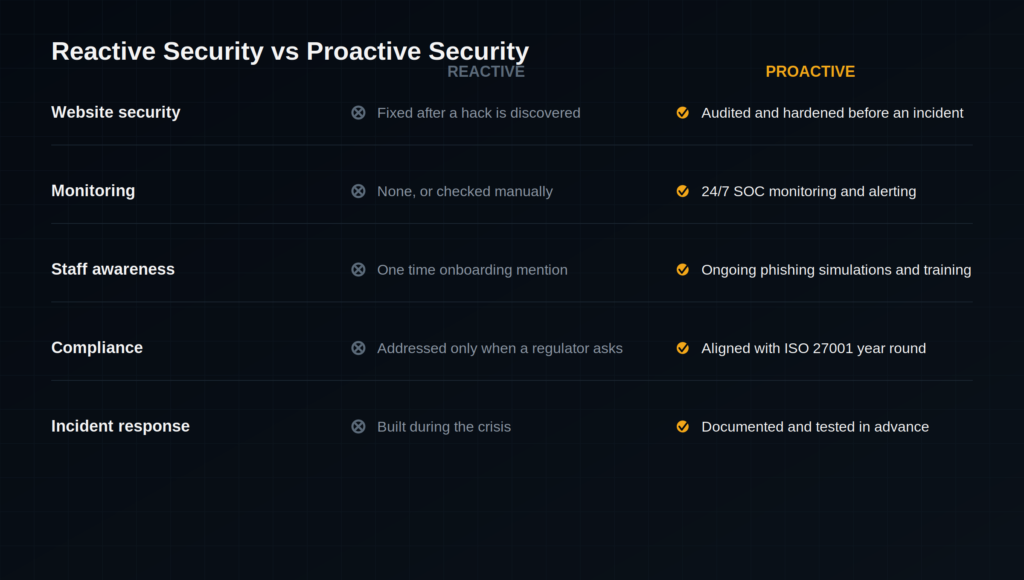
| Area | Reactive Approach | Proactive Approach (Ambsan Model) |
| Website security | Fixed after a hack is discovered | Regularly audited and hardened before an incident |
| Monitoring | None, or checked manually | 24/7 SOC monitoring and alerting |
| Staff awareness | One time onboarding mention | Ongoing phishing simulations and training |
| Compliance | Addressed only when a regulator asks | Aligned with ISO 27001 and sector requirements year round |
| Incident response | Built during the crisis | Documented and tested in advance |
| Breach notification | Scrambled together after discovery | Ready to meet a 72 hour notification standard |
How Ambsan Helps Businesses Get Ahead of These Numbers
Ambsan Technologies works with businesses across Pakistan, from local SMEs to large enterprises, and with clients in the United States through our Huntington Beach office. Our approach combines 24/7 SOC monitoring, ISO 27001 aligned audits, and hands on incident response, built around the real threat data coming out of Pakistan, not generic frameworks borrowed from other markets.
Whether you need a one time Application Security review or ongoing Identity and Access Management support, our team can help you move from reactive to proactive before you become part of next quarter’s statistics.
Questions to Ask Before You Assume You Are Safe
Do not assume your business is too small, too niche, or too unknown to be targeted. Ask your IT team or provider these direct questions: When was our last security assessment? Who is monitoring our systems outside business hours? What is our actual plan if we are breached tomorrow? Could we notify customers within 72 hours if we had to?
If those answers feel vague, that is the clearest signal that it is time for an outside review. Our assessment process is built to answer exactly these questions, with a clear report and a prioritized action plan, not just a list of problems handed back to you with no path forward.
Frequently Asked Questions
How many cyberattacks happened in Pakistan in 2026?
Pakistan reported 98 cyberattacks in the first three months of 2026 alone, targeting government institutions, businesses, and educational organizations. This followed 111 attacks on federal institutions and 137 on provincial governments across all of 2025.
What is the most common type of cyberattack in Pakistan?
Website hacking was the most common attack type reported, accounting for 42 of the 98 incidents in the first quarter of 2026, well ahead of phishing campaigns and fake website scams.
Are Pakistani businesses actually being targeted, or is it mostly government?
Both. Sixteen of the reported incidents in early 2026 hit the business sector directly. Government remains the largest target group, but private businesses of all sizes were affected, and many incidents likely go unreported.
What is a sectoral CERT and does it apply to my business?
A sectoral CERT is a designated computer emergency response team within a specific industry regulator, such as the State Bank of Pakistan or the Pakistan Telecommunication Authority. If your business is regulated by one of these bodies, new incident reporting and monitoring expectations likely apply to you.
How can a small business protect itself with a limited budget?
Start with the highest impact, lowest cost steps: multi factor authentication, regular website patching, staff phishing awareness training, and tested backups. These alone prevent the majority of common attack types seen in the 2026 data.
Does Pakistan have a mandatory data breach notification law?
Not yet in a single unified form. The Prevention of Electronic Crimes Act covers unauthorized access and data misuse, and draft data protection rules propose a 72 hour notification window, but a fully binding, universal breach notification law is still pending.
What industries were hit hardest in early 2026?
Provincial and federal government institutions accounted for the largest share, followed by the business sector and educational institutions. Telecom, health, power, and media sectors each recorded smaller but notable incident counts.
How often should a business run a cybersecurity audit?
At minimum once a year, though businesses handling sensitive customer data, payments, or regulated information should consider more frequent assessments, especially given the pace of new incidents reported in 2026.
What does 24/7 SOC monitoring actually catch that basic antivirus misses?
Antivirus tools catch known threats on individual devices. A security operations center monitors network activity continuously, spotting unusual behavior, unauthorized access attempts, and early signs of compromise across your entire environment, often before real damage occurs.
Why do so few Pakistani businesses report cyberattacks?
Many companies fear reputational damage, loss of client trust, or regulatory attention more than the attack itself. Without a legal requirement to disclose in most cases, businesses often choose to handle incidents quietly, which makes the true scale of the problem harder to measure.
What should be the very first step after discovering a breach?
Contain the incident first by isolating affected systems, then preserve evidence for investigation before making changes. Bring in a qualified incident response team quickly, since early missteps can destroy the forensic trail needed to understand what happened and prevent it from happening again.
Final Thoughts
The 2026 data is clear. Pakistan is facing near daily cyberattacks, website hacking remains the top method, and businesses are far from immune. The trend from 2025 has not slowed down, regulators are tightening requirements around sectoral CERTs and breach notification, and the gap between reactive and proactive security is only getting more expensive to ignore.
None of this means panic is the right response. It means prioritization. Fix the highest impact, lowest cost gaps first, treat the 72 hour notification standard as your working benchmark even before it becomes law, and build monitoring and response capability before you need it rather than after.
For more on how these numbers connect to what regulators now expect, read our posts on the new SOC deadline for Pakistani businesses, ransomware in Pakistan, and how to choose the right cybersecurity company for your business.
If you want to know exactly where your business stands against threats like these, talk to our security team or schedule a consultation today.