
Three testing methods, three completely different views of your risk. Picking the wrong one means paying for a test that answers a question you were not actually asking.
A Karachi based fintech books a penetration test, gets a clean report two weeks later, and feels confident going into its next funding round. Four months after that, they get breached through an employee account nobody thought to test, because the test they paid for was never designed to find that kind of weakness in the first place.
This happens more often than it should, not because the testing was bad, but because the wrong type of test was chosen for the risk that actually mattered. Black box, white box, and grey box penetration testing are not three quality tiers. They are three completely different questions, and picking the wrong one means you get a real, professional, accurate answer to a question you were not actually asking.
This guide breaks down what each testing type actually does, when each one is the right call, and how to decide which fits your business instead of picking based on price or a vendor’s default package.
Distinct testing methodologies, each answering a different security question
60% of breaches are estimated to involve insider access or credentials, not pure external attacks
Wrong choice can mean months of undetected exposure in exactly the area you needed tested
The Real Question Behind Black Box, White Box, and Grey Box Testing
Every penetration test starts with the same underlying question: how much does the tester know about your system before they begin. That single variable, knowledge level, is what separates the three approaches, and it changes everything about what the test can realistically find.
Black box testers know nothing going in. White box testers know everything. Grey box testers sit somewhere in between. None of these is universally better. Each simulates a different kind of attacker, and your business almost certainly faces more than one kind.
What Black Box Penetration Testing Actually Means
In a black box test, the tester is handed nothing but a target, your public website, your IP range, your company name, and is expected to find a way in exactly like an outside attacker would. No source code, no architecture diagrams, no credentials, no internal documentation.
This is the closest simulation of a real world opportunistic attacker. It tests your actual external defenses, not just your code. Reconnaissance is part of the engagement itself, so the tester spends real time mapping what is publicly visible about your organization before attempting anything.
What White Box Penetration Testing Actually Means
White box testing is the opposite extreme. The tester receives full access, source code, network diagrams, credentials, architecture documentation, and sometimes even a seat alongside your development team. Nothing is hidden.
This depth means white box testing can uncover vulnerabilities buried deep in application logic or configuration that would be nearly impossible to find from the outside in a limited engagement window. The tradeoff is that white box testing is the slowest and most resource intensive of the three, since there is simply more information to work through.
What Grey Box Penetration Testing Actually Means
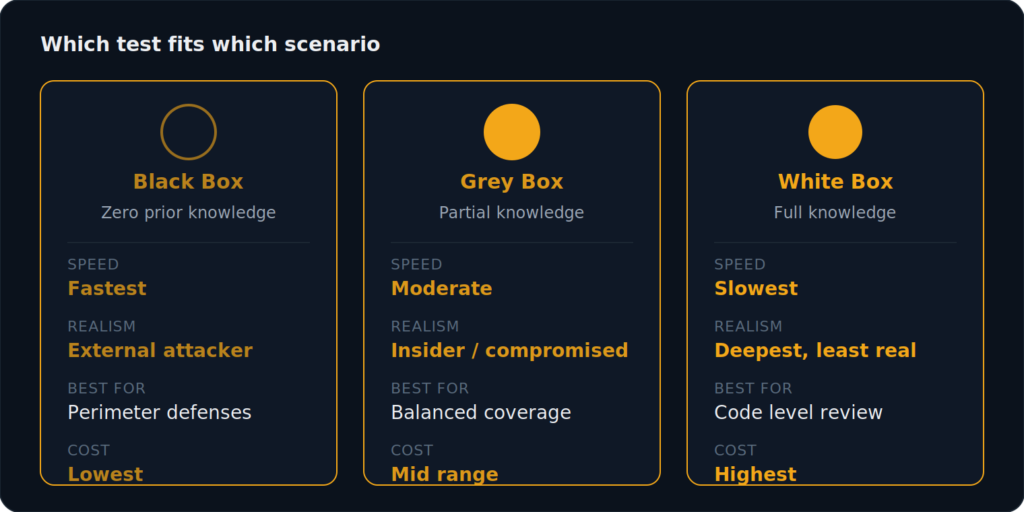
Grey box testing gives the tester partial information, maybe a standard user account, maybe a general sense of the network layout, but not full access. This is designed to simulate a specific and very common real world scenario, an attacker who already has some foothold, whether through a phished employee account, a leaked credential, or a compromised third party vendor.
Grey box testing tends to be the most practical middle ground for businesses that want realistic results without the multi week time investment white box testing usually requires.
The One Factor That Actually Decides Which Test You Need
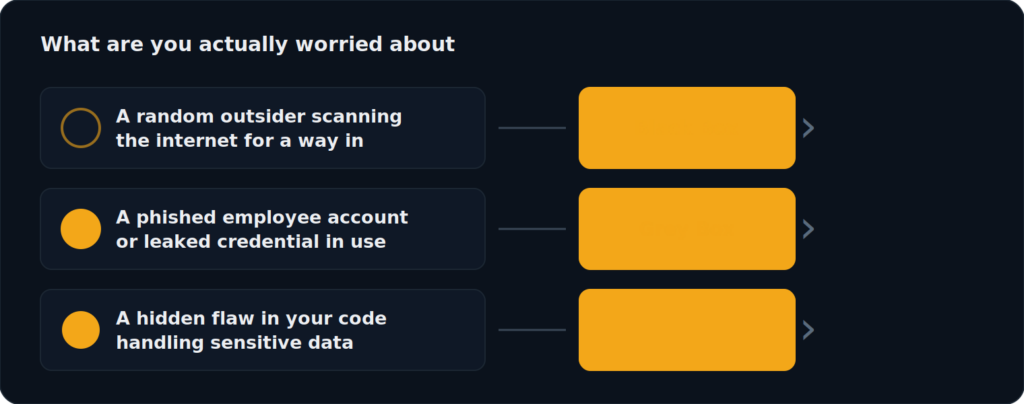
Strip away the terminology and the decision comes down to one question: what kind of attacker are you most worried about right now. An opportunistic hacker scanning the internet for exposed systems is a black box scenario. A malicious or careless insider is a grey box scenario. A determined, well resourced attacker who has done extensive research on your organization, or a need to validate your code itself, points toward white box.
Most businesses are not choosing between good and bad testing. They are choosing between testing the front door, testing what happens after someone is already inside, and testing the building’s blueprints for structural flaws.
Not sure which scenario matches your actual risk?
Book a free security assessment and Ambsan’s team will help you scope the right test before you pay for the wrong one.
When Black Box Testing Is the Right Call
- You want to know what an outside attacker with zero insider knowledge could actually find and exploit
- You are validating perimeter defenses, firewalls, public facing applications, exposed services
- You need a realistic, time boxed simulation of an opportunistic attack rather than an exhaustive audit
- You have limited time or budget and want the most attacker realistic test for the investment
When White Box Testing Is the Right Call
- Your system processes sensitive financial, medical, or personally identifiable data where deep flaws carry serious consequences
- You suspect a specific weakness exists in your code, database structure, or integration logic
- You are conducting a pre launch security review of new software before it goes live
- You need a comprehensive internal audit, not just a simulated attack, often ahead of a compliance deadline
When Grey Box Testing Is the Right Call
- You want to test both external and internal exposure without the full time investment of white box testing
- You are concerned about insider threats, whether malicious employees or simple negligence
- You want to simulate what happens after a phishing attempt succeeds or a credential leaks
- You need a balanced, practical test for an annual or recurring compliance cycle
Why Insider Threats Change the Calculus
A large share of real world breaches are estimated to involve some form of insider access, whether through a compromised employee credential, a careless mistake, or an actual malicious insider, rather than a purely external attacker breaking through a firewall from scratch. A black box test alone does not simulate this scenario at all, because it assumes the attacker starts with nothing.
This is exactly why grey box testing has become the default recommendation for many businesses rather than an afterthought. It is the only one of the three that directly tests what happens once someone, whether an outsider or an insider, already has a foothold.
Why this matters
If your penetration testing strategy only ever tests the front door, you are leaving the scenario responsible for a large share of real breaches completely unexamined.
Black Box vs White Box vs Grey Box: Side by Side Comparison
| Factor | Black Box | Grey Box | White Box |
|---|---|---|---|
| Tester’s starting knowledge | None | Partial | Full |
| Realism vs a real attacker | Highest for external threats | Highest for insider or compromised account scenarios | Lowest realism, highest depth |
| Typical time required | Shortest | Moderate | Longest |
| Best for | Perimeter and external defenses | Insider risk, phishing follow through, balanced coverage | Deep code level and architectural flaws |
| Risk of missed findings | Higher, limited time and access | Moderate | Lowest, but can miss what a true outsider would notice first |
Cost and Time Differences Between the Three Approaches
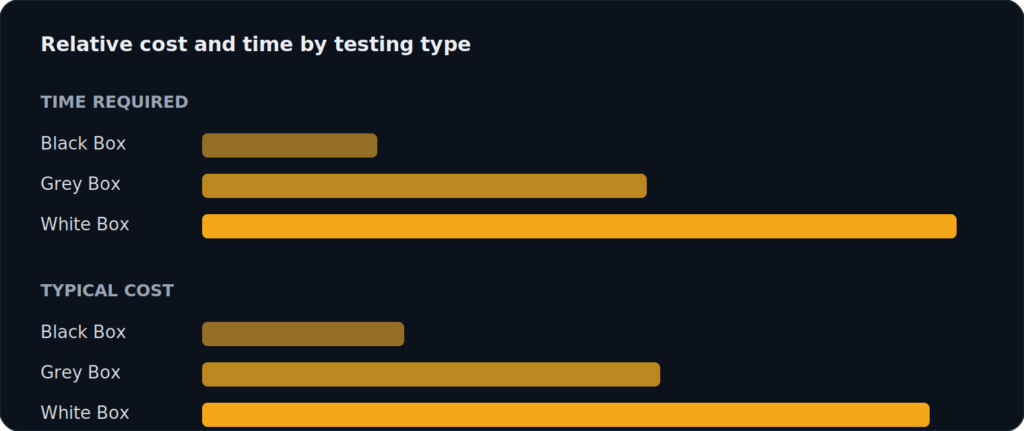
Black box engagements are generally the fastest and least expensive of the three, since testers are working with limited access and a defined, time boxed scope. Grey box sits in the middle on both cost and duration. White box testing takes the longest and typically costs the most, simply because there is far more ground for a tester to cover when they have full access to source code and architecture documentation.
None of these costs should be the deciding factor on its own. A cheap black box test that misses an insider risk scenario your business actually faces is not a good deal, it is a false sense of security with a receipt attached.
Common Mistake: Choosing Based on Price, Not Risk
The most common mistake Ambsan’s team sees in Pakistani businesses booking their first penetration test is choosing the cheapest available option without asking what that option actually tests for. A black box test bought purely because it is the fastest and least expensive package will not tell you anything about insider risk, no matter how thorough the report looks.
The right question is never which test is cheapest. It is which test answers the security question that actually keeps you up at night.
What Ambsan’s VAPT Process Actually Looks Like
Ambsan’s VAPT service combines detailed security audits with simulated real world attacks across networks, web applications, and endpoints, carried out by ethical hacking specialists rather than automated scanners alone. Rather than defaulting every client to the same testing type, the process starts with understanding what your business actually needs to validate, whether that is perimeter resilience, insider risk, or a deep code level review, before scoping the right combination of black box, grey box, or white box work.
This work also feeds directly into Ambsan’s Zero Trust Architecture implementation, since the vulnerabilities a VAPT engagement uncovers are often the exact gaps a Zero Trust model is designed to close going forward.
Find out which test actually fits your risk
Ambsan’s security team reviews your systems and risk profile, then recommends the right testing approach instead of a default package.
Book a Free Security Assessment
Can You Combine Testing Types
Yes, and for many businesses this is the most practical long term approach. A common pattern is running a black box test to validate perimeter defenses on a regular cycle, then a grey box test to simulate insider and post phishing scenarios, and reserving full white box reviews for major new applications before launch or ahead of specific compliance deadlines. Testing does not have to be an either or decision made once a year.
Which Test Satisfies Which Compliance Requirement
Compliance frameworks like PCI DSS, ISO 27001, and Pakistan’s State Bank cybersecurity requirements generally do not mandate one specific testing methodology by name. What they require is evidence that testing was thorough, regular, and appropriate to the risk of the systems involved. In practice, this often means a combination approach, black box for external facing payment or customer systems, and grey box or white box for internal systems handling sensitive data, gives auditors the strongest evidence of a mature security program.
Decision Checklist: Which Test Fits Your Business
- If your main concern is what a random outside attacker could find, start with black box
- If you are worried about phishing, leaked credentials, or insider risk, choose grey box
- If you are launching new software handling sensitive data, invest in white box before go live
- If you have never tested before, a grey box engagement usually gives the most balanced first look
- If you are under a compliance deadline, ask your auditor what evidence they expect before choosing
- If budget is limited, prioritize the test that matches your highest actual risk, not the cheapest option
What Happens After the Test Matters More Than Which Type You Chose
Here is the part that gets overlooked regardless of which testing type a business picks. A penetration test, of any kind, is only valuable if the findings actually get fixed. A perfectly scoped grey box engagement that uncovers three critical vulnerabilities is worthless if those vulnerabilities sit in a PDF for six months while nobody owns the remediation. The testing type determines what gets found. What happens next determines whether it protects you at all.
Talk to Ambsan before your next penetration test
Get the right testing approach scoped to your actual risk, plus support turning findings into fixes, not just a report.
Frequently Asked Questions
Which is better, black box, white box, or grey box penetration testing?
None is universally better. Each simulates a different kind of attacker and answers a different question. Black box is best for testing external defenses, white box for deep code level review, and grey box for insider risk and balanced coverage.
Which penetration testing type is fastest?
Black box testing is generally the fastest, since testers work with limited access and a defined scope. White box testing takes the longest because testers have to work through full source code and architecture documentation.
Is grey box testing the same as an insider threat test?
They overlap closely. Grey box testing simulates an attacker with partial access, which closely mirrors what happens after a phishing attempt succeeds or a credential is leaked, both common paths for insider style risk.
Do I need all three types of penetration testing?
Not necessarily at once. Many businesses combine them over time, using black box for regular perimeter checks, grey box for balanced annual testing, and white box for major new applications or specific compliance needs.
How much does a penetration test cost in Pakistan?
Cost depends heavily on which type of test, the scope of systems involved, and the size of your environment. Black box tests are typically the least expensive, white box the most, with grey box in between. Ambsan provides tailored quotes after an initial assessment.
Can a black box test miss vulnerabilities a white box test would find?
Yes. Because black box testers work with no internal knowledge and a limited time window, they can miss deep, buried vulnerabilities that a white box tester would find by reviewing source code and architecture directly.
What information do I need to provide for a white box test?
Typically source code access, architecture documentation, network diagrams, and credentials. The more information provided, the deeper and more comprehensive the review can be.
How often should a business run penetration testing?
Most compliance frameworks and security best practices recommend at least annually, with additional testing after major system changes, new application launches, or significant infrastructure updates.
What happens after a penetration test finds vulnerabilities?
The findings should move into a remediation plan with clear ownership and timelines. A test is only valuable if the vulnerabilities it finds actually get fixed, which is why remediation support matters as much as the testing itself.
Final Thoughts
Black box, white box, and grey box penetration testing are not a hierarchy of quality. They are three different lenses on your risk, and the right choice depends entirely on what kind of attacker, or what kind of vulnerability, you actually need to find. Most mature security programs eventually use all three at different points, not because more testing is always better, but because different questions require different tools.
The businesses that get real value from penetration testing are the ones that start by asking what they are actually worried about, not which package is cheapest, and that follow through on fixing what the test finds.
Related: Vulnerability Assessment and Penetration Testing Services at Ambsan
Related: Third Party Vendor Risk, How One Breach Sinks a Business
Ready to scope the right penetration test for your business?
Book a free, no obligation consultation with Ambsan’s security team and get a testing plan built around your actual risk.
Ambsan Technologies is a Karachi based cybersecurity firm serving businesses across Pakistan and the United States, offering VAPT, network security, and managed IT services for SMEs and enterprises.