
A SIEM collects and displays alerts. It does not read them, prioritize them, or respond to them. That part requires a SOC, and most businesses that own a SIEM do not actually have one behind it.
A mid sized business in Lahore proudly tells its board it invested in a SIEM platform last year, real time visibility across the network, dashboards, alerts, everything a modern security setup should have. Six months later, an attacker sits inside the network for eleven days before anyone notices, not because the SIEM failed to generate an alert, it generated several, but because nobody was actually watching the dashboard those alerts appeared on.
This is one of the most common and most expensive misunderstandings in cybersecurity purchasing. A SIEM and a SOC are not the same thing, and buying one does not mean you have the other. A SIEM is a tool that collects and correlates security data. A SOC is the team of people who actually look at what it produces, decide what matters, and respond. Confusing the two leaves businesses with exactly the kind of blind spot the tool was supposed to eliminate.
This guide breaks down what each term actually means, why the gap between them causes real breaches, and how to know whether your own alerts are actually being seen by anyone at all.
The Question That Exposes the Gap: Who Is Actually Looking at This
Ask any business that owns a SIEM one simple question: who reviewed yesterday’s alerts. The answer reveals almost everything about whether that investment is actually protecting the business. A dashboard full of alerts that nobody reviewed is not meaningfully different from having no monitoring at all, except that it creates a false sense of security that makes the gap more dangerous, not less.
What a SIEM Actually Is
Security Information and Event Management, SIEM, is software that collects log and event data from across a business’s network, firewalls, servers, endpoints, applications, and correlates it to identify potentially suspicious activity. It is genuinely useful infrastructure. It centralizes visibility that would otherwise be scattered across dozens of separate tools. What it does not do is decide, on its own, which of the alerts it generates represent a real threat worth acting on.
What a SOC Actually Is
A Security Operations Center, SOC, is the team, and the processes around that team, responsible for actually reviewing what a SIEM and other security tools produce, investigating suspicious activity, and responding to confirmed incidents. A SOC can use a SIEM as one of its primary tools, but the SOC is the people and the workflow, triage, escalation, response, not the software itself.
The Core Difference: A Tool That Collects vs A Team That Watches
Think of a SIEM as a security camera system, dozens of feeds, recording constantly, technically capturing everything that happens. A SOC is the person actually watching those screens, or reviewing the footage promptly enough to act on what they see. A building can have the most advanced camera system available and still get robbed if no one is watching the monitors, or if the recordings are only reviewed after someone reports something missing.
Why Businesses Buy a SIEM and Assume They’re Covered
This is rarely a mistake made carelessly. SIEM platforms are marketed around visibility, dashboards, real time alerts, compliance reporting, and all of that is genuinely delivered. What is less often made clear at the point of sale is that the platform’s value is entirely dependent on someone reviewing its output consistently. A business can complete a SIEM deployment successfully, pass every technical checkbox, and still have no meaningful improvement in actual threat detection if the monitoring side was never built out.
The Alert Volume Problem: What a SIEM Actually Generates
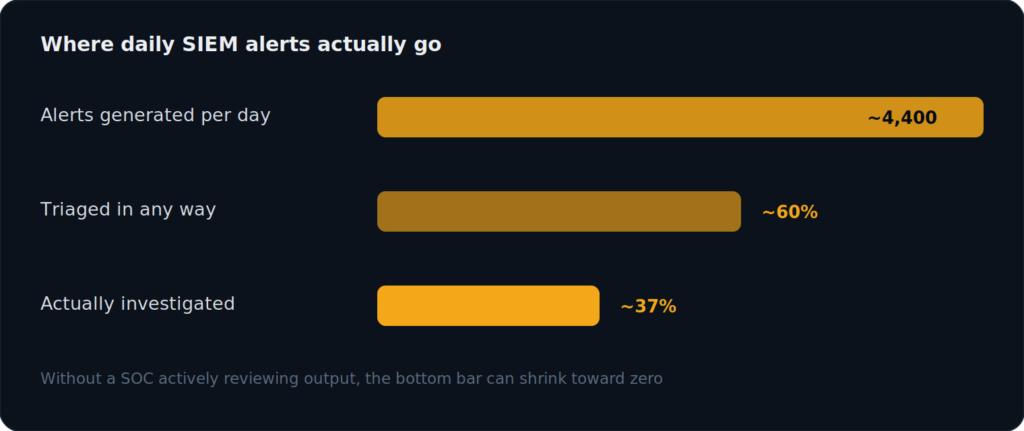
A typical enterprise SOC processes over four thousand alerts a day, and larger organizations running many integrated security tools can see ten thousand or more. Recent research indicates only around 37 percent of these alerts are actually investigated in any meaningful way. The rest are triaged superficially, deprioritized, or simply never reviewed. This is not a reflection of a poorly built SIEM. It is the mathematical reality of alert volume exceeding what any reasonable number of humans can manually review.
Why Alert Fatigue Happens, and Why It’s Not a Tuning Problem
Alert fatigue is the desensitization that happens when analysts face a volume of alerts that exceeds what they can realistically process, leading them to miss, delay, or ignore alerts that matter, including genuinely serious ones. This is often mistakenly treated as something that better SIEM tuning alone can fix. Tuning helps at the margins, adjusting correlation rules, raising thresholds, but even a perfectly tuned SIEM will produce fatigue if the volume of legitimate alerts still exceeds the capacity of the team reviewing them. The structural fix is having enough of the right people and process, not just better software configuration.
Why this matters
A false positive rate above 50 percent is common in many SOC environments. When half of everything an analyst reviews turns out to be noise, trust in the alert stream itself erodes, and that erosion is exactly when real incidents start slipping through.
The Target Breach: A Real World Case of Alerts Nobody Watched
One of the most widely referenced examples of this exact failure mode is the 2013 Target data breach, in which security monitoring tools reportedly did generate alerts about the suspicious activity that led to a massive theft of customer payment data, but those alerts were not acted upon in time to prevent the breach. The tooling was not the point of failure. The gap was in review and response, precisely the SOC side of the equation.
What Happens to an Alert With No SOC Behind It
An alert that nobody reviews does not disappear, it simply sits in a dashboard, accumulating alongside thousands of others, none of them prioritized, none of them investigated. If that alert happened to represent a real, active intrusion, the business has no meaningfully better position than if the SIEM had never generated it at all, except for the cost already spent on the platform and the false confidence that comes with having “monitoring” in place.
Not sure whether your alerts are actually being reviewed?
Book a free security assessment and Ambsan’s team will show you exactly what your current setup is catching, and what it’s missing.
SIEM Alone vs SIEM Plus SOC: Side by Side
| Factor | SIEM Alone | SIEM Plus SOC |
|---|---|---|
| Alert generation | Yes, continuous | Yes, continuous |
| Alert review | Inconsistent or none | Structured triage by trained analysts |
| Response to real threats | Only if someone happens to notice | Defined escalation and response process |
| False positive filtering | Left entirely to whoever checks the dashboard | Actively managed through experience and tuning |
| Coverage hours | Whenever someone happens to look | Typically 24/7 |
Can a Small Business Run Its Own SOC
Technically, yes, but the practical challenges are significant. Round the clock coverage alone requires multiple analysts across shifts, not one IT generalist checking a dashboard during business hours. Add specialized training, tooling costs, and the reality that security talent is expensive and in high demand, and building a genuinely effective in house SOC becomes a substantial undertaking that few small or mid sized businesses can justify on their own.
Managed SOC: The Middle Ground Most Businesses Actually Need
A managed SOC service provides the team and process side of the equation without requiring a business to hire, train, and staff its own around the clock security operation. This is generally the more realistic path for small and mid sized businesses, genuine alert review and response capability, without the overhead of building an internal team from scratch.
What a SOC Analyst Actually Does With an Alert
- Triages the alert against severity and asset value, is this a routine policy notice or a potential active threat
- Cross references the alert with other data, other tools, other recent activity, to build real context
- Determines whether the alert represents a genuine incident or a false positive, and documents the reasoning
- Escalates confirmed incidents through a defined response process, containment, investigation, remediation
- Feeds findings back into tuning, so the same noisy alert pattern doesn’t repeat unnecessarily
Signs Your SIEM Has No One Actually Watching It
- Nobody in the business can tell you, off the top of their head, how many alerts came in yesterday
- Alerts are reviewed only when someone happens to have spare time, not on a defined schedule
- There is no documented process for what happens after an alert is flagged as serious
- The SIEM was deployed as a project with a completion date, but no ongoing operational plan followed
- Nobody could tell you the current false positive rate, because nobody is tracking outcomes at all
How Ambsan’s SOC Monitoring Works With Your Existing Tools
Ambsan’s 24/7 SOC Monitoring service is built specifically to close this exact gap, providing the team and process behind whatever detection tools a business already has, SIEM, EDR, firewall logs, rather than requiring a business to replace its existing investment. Alerts are triaged, investigated, and escalated by an actual team working around the clock, so the alerts your tools already generate translate into real action instead of accumulating unread in a dashboard.
This work connects directly to Ambsan’s broader detection and response approach, correlating signals across endpoint, network, and identity tools rather than treating each alert source in isolation.
Find out if your alerts are actually being watched
Ambsan’s team reviews your current monitoring setup and shows you exactly what’s being caught, and what’s slipping through unreviewed.
Book a Free Security Assessment
Explore SOC Monitoring
What to Ask Before Buying a SIEM, or Realizing You Already Own One
- Who specifically will review the alerts this platform generates, and on what schedule
- What happens, step by step, when an alert is flagged as high severity
- Is coverage limited to business hours, or genuinely round the clock
- What is the realistic expected volume of daily alerts for a business our size
- Does the vendor or partner provide the monitoring team, or only the software
Building Detection and Response as One System, Not Two Purchases
The businesses that get real value from a SIEM investment treat detection and response as one connected capability from the start, not a software purchase followed by a separate, later decision about who will actually watch it. Whether that monitoring capability is built in house or brought in through a managed SOC service, the tool and the team need to be planned together, because a SIEM without a SOC behind it is, functionally, a very expensive way to generate alerts nobody sees.
Talk to Ambsan about closing the gap behind your alerts
Get a monitoring setup where every alert your tools generate actually gets reviewed by someone.
Talk to Our Security Team
Frequently Asked Questions
What is the difference between a SIEM and a SOC?
A SIEM is software that collects and correlates security event data, generating alerts. A SOC is the team of people, and the processes around them, who review those alerts, investigate suspicious activity, and respond to confirmed incidents. A SIEM can exist without a SOC, but its alerts will largely go unreviewed.
Does owning a SIEM mean my business is being monitored?
Not necessarily. A SIEM generates alerts, but whether those alerts are actually reviewed depends entirely on whether a team, internal or managed, is consistently triaging and investigating them. Many businesses that own a SIEM have no structured process reviewing its output.
How many alerts does a typical SIEM generate per day?
Enterprise SOCs commonly report over 4,000 alerts daily, with larger organizations running many integrated tools seeing 10,000 or more. Research indicates only around a third of these alerts are typically investigated in meaningful detail.
What is alert fatigue?
Alert fatigue is the desensitization security analysts experience when facing a volume of alerts that exceeds their realistic capacity to review, leading to missed, delayed, or ignored alerts, including ones that represent genuine threats.
Can a small business afford to run its own SOC?
Building a fully staffed, round the clock in house SOC is expensive and resource intensive for most small and mid sized businesses. A managed SOC service typically provides equivalent monitoring capability without the cost of building an internal team from scratch.
What does a SOC analyst actually do?
A SOC analyst triages incoming alerts, investigates suspicious activity with additional context, determines whether an alert represents a genuine threat or a false positive, and escalates confirmed incidents through a defined response process.
Is a managed SOC the same as a SIEM subscription?
No. A SIEM subscription typically provides the software platform for collecting and displaying alerts. A managed SOC service provides the team that actually reviews, investigates, and responds to what that platform, or other security tools, generate.
How do I know if my current monitoring setup is actually working?
Ask who specifically reviews alerts, how often, and what the documented process is for escalating a serious finding. If those questions don’t have clear answers, alerts are likely accumulating without meaningful review.
What’s the difference between an alert and an incident?
An alert is a signal generated by a tool indicating potentially suspicious activity. An incident is a confirmed, investigated threat. The gap between the two widens significantly when alert fatigue causes analysts, or the absence of analysts, to treat every alert as noise by default.
Final Thoughts
A SIEM is genuinely valuable infrastructure, but it answers only half the question a business actually needs answered, which is not “can we see suspicious activity” but “will someone actually notice and respond to it in time.” That second half is the SOC, and it is a team and a process, not a feature that comes bundled with the software license.
The businesses that get breached despite having “monitoring” in place are rarely the ones with a bad SIEM. They are the ones who never built, or never bought, the team that was supposed to be watching it.
Ready to find out if your alerts are actually being seen?
Book a free, no obligation consultation with Ambsan’s team and get a clear picture of your real monitoring coverage.
Schedule a Consultation
See All Services
Ambsan Technologies is a Karachi based cybersecurity firm serving businesses across Pakistan and the United States, offering 24/7 SOC monitoring, threat detection and response, and managed IT services for SMEs and enterprises.