
Most businesses run one training session a year and call it done. The data shows that approach barely moves the number that actually matters. Here is what does.
Every employee at a mid sized Lahore firm sits through the same cybersecurity training video every January, clicks through a ten question quiz, and gets a completion certificate. Eleven months later, a phishing simulation is run without warning. More than a third of the same employees click the link. The training happened. The behavior did not change. This is not a rare outcome. It is the default outcome of training run this way.
Cybersecurity training has a measurement problem. Most businesses track whether training happened, completion rates, certificates issued, a box ticked for the auditor. Almost none track the number that actually predicts whether a business gets breached through a phishing email, the click rate on a realistic, unannounced simulation. Those two numbers are only loosely related, and the gap between them is where most training budgets quietly go to waste.
This guide walks through what the research actually shows about training effectiveness, why frequency matters more than almost any other variable, and how Ambsan structures a training and awareness program built around the metric that actually matters.
33% Of untrained employees click a phishing simulation on average, roughly one in three
86% Reduction in click rate achieved after 12 months of consistent monthly simulation and training
75% Of that reduction is directly attributable to monthly cadence rather than quarterly or annual training
The Compliance Training Everyone Forgets by Lunch
Annual, video based training is not worthless, employees do walk away with some baseline awareness. The problem is retention. Research on skill acquisition consistently shows that awareness gained in a single training session erodes within a few months without reinforcement. By the time a real phishing email arrives eight or nine months later, the training that was supposed to prevent that exact moment has largely faded.
What the Data Actually Shows About Annual Training
Businesses running only annual, one off training sessions see minimal long term change in actual click behavior. In some documented cases, training that builds overconfidence without reinforcement can actually increase susceptibility to simple phishing attempts, employees believe they have learned the lesson and lower their guard, without the habitual caution that only comes from repeated practice.
The Number That Matters More Than Completion Rate: Click Rate
Completion rate answers one question: did employees sit through the training. Click rate, the percentage of employees who interact with a realistic, unannounced phishing simulation, answers the question that actually matters: would this workforce fall for a real attack right now. A business can have a 100 percent training completion rate and a 33 percent click rate at the same time. Only one of those numbers predicts breach risk.
Why One in Three Employees Click Before Any Training
Industry benchmark data puts the untrained baseline click rate at close to one in three employees, and in some regions closer to two in five. This is not a reflection of carelessness. Phishing emails are specifically designed to exploit routine behavior, urgency, familiarity, authority, and the average phishing email is opened within minutes of arriving, before any conscious evaluation has time to happen. Starting from this baseline is normal. Staying there is the actual problem.
The Variable That Changes Everything: Frequency
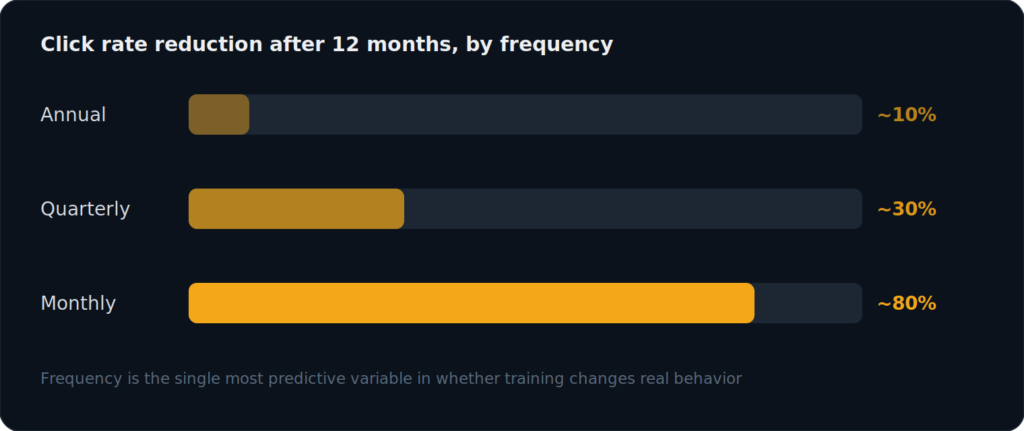
Across the available research, one variable predicts program success more consistently than any other, how often simulations run. Organizations running monthly simulations see meaningfully greater click rate reduction over a year than those running quarterly, and quarterly outperforms annual by a wide margin. This is not a marginal difference. It is the difference between a program that changes behavior and one that mostly satisfies a compliance requirement.
Monthly vs Quarterly vs Annual: What the Research Actually Shows
| Cadence | Typical 12 month click rate reduction | What actually happens |
|---|---|---|
| Annual | Minimal, often under 10% | Awareness fades well before the next session |
| Quarterly | Roughly 25 to 35% | Some habit formation, but gaps between cycles allow vigilance to partially erode |
| Monthly | Roughly 75 to 86% | Never enough time between campaigns for habits to fully fade |
Just in Time Training: Why the Moment After a Click Matters Most
An employee who clicks a simulated phishing link and immediately receives a short, specific explanation of what they missed is in a uniquely receptive state, the mistake is fresh, personal, and concrete. Just in time training delivered at that exact moment produces meaningfully better retention than a scheduled training module reviewed weeks later, disconnected from any real decision the employee made.
Why this matters
A training video watched in isolation teaches a concept. A short explanation delivered immediately after a real mistake teaches a lesson the brain actually keeps.
Escalating Difficulty: Why Easy Simulations Stop Working After Month Three
A program that sends the same generic template every month stops producing useful data quickly, employees learn to recognize the simulation itself rather than developing genuine phishing awareness. Effective programs increase difficulty over time, starting with generic templates, moving to contextual phishing referencing internal tools or services, and eventually spear phishing style simulations referencing real colleagues or projects. This mirrors how real attackers actually operate, and keeps the click rate metric meaningful rather than a vanity number.
The Metric Nobody Tracks: Reporting Rate
Click rate measures failure. Reporting rate, the percentage of employees who actively flag a simulated phishing email to the security team rather than simply ignoring or clicking it, measures something more valuable, active participation in the business’s defense. Industry average reporting rates sit surprisingly low, often below 20 percent, while the strongest security cultures reach well over half. Tracking reporting rate alongside click rate gives a far more complete picture than click rate alone.
Not sure what your current training program is actually achieving?
Book a free security assessment and Ambsan’s team will help you establish a real baseline.
Repeat Clickers: The 10 Percent Who Need a Different Approach
After a few months of consistent simulation, a clear pattern usually emerges, a small group of employees, often referred to as repeat clickers, who fail multiple consecutive simulations while the rest of the organization improves. This group deserves targeted follow up, additional one on one training or role specific coaching, rather than being treated identically to employees who clicked once and then adjusted.
Why Punishment Based Training Backfires
Programs that publicly shame or penalize employees for clicking a simulation tend to suppress reporting rather than improve behavior. Employees become reluctant to admit mistakes, including real ones, out of fear of consequences, which is precisely the opposite of what a security aware culture needs. A documented, no punishment click policy, paired with genuine, judgment free coaching, consistently produces better long term results.
What a Properly Run Program Looks Like Month by Month
- Months 1 to 2, generic phishing templates establish a real baseline click rate before any targeted training begins
- Months 3 to 4, contextual phishing referencing internal tools and daily workflows raises the difficulty appropriately
- Months 5 to 6, spear phishing style simulations referencing real colleagues or projects test genuine vigilance
- Month 7 onward, multi vector scenarios combining email, QR codes, or fake calls reflect how real attacks increasingly work
Building Simulations Around Real Threats, Not Generic Templates
A simulation program that never evolves teaches employees to recognize outdated attack patterns. Real phishing continues to evolve, QR code based phishing that bypasses email link scanners, urgent financial requests referencing real vendors, multi channel scams combining email and phone calls. A training program worth running reflects the actual threat landscape a business faces, not a static library of templates from several years ago.
How This Connects to the Rest of Your Security Stack
Training does not replace technical controls, it complements them. A well trained employee who reports a suspicious email gives your SOC an early signal before an attack progresses. A phishing email that does get clicked is far less damaging when EDR is watching endpoint behavior and MFA is protecting the account being targeted. Training and technical defenses catch different failure points, and the strongest programs treat them as one connected system rather than separate initiatives.
What Ambsan’s Training and Awareness Approach Actually Delivers
Ambsan’s Training and Awareness service is built around the frequency and escalation principles the research consistently supports, not a single annual session treated as a compliance formality. Programs are structured around realistic, evolving simulations, just in time coaching delivered at the moment of a click, and clear reporting to leadership using click rate and reporting rate trends rather than completion percentages alone.
This work connects directly to Ambsan’s broader security stack, SOC monitoring, endpoint security, and identity controls, so a reported phishing attempt becomes an actionable signal across the business, not an isolated data point.
Find out what your current training program actually achieves
Ambsan’s team runs a baseline phishing simulation and shows you exactly where your organization stands, no assumptions, real numbers.
Book a Free Security Assessment
Explore Training and Awareness
Reporting Results to Leadership: What to Measure and Why
Leadership reporting works best framed in risk language rather than training language. A falling click rate represents a measurable reduction in successful phishing preconditions across the business. A rising reporting rate represents a workforce actively participating in defense rather than passively hoping not to be targeted. Trend data over several quarters tells a far more useful story than a single point in time score, and gives leadership a genuine basis for evaluating whether the training investment is working.
Getting Started: What the First 90 Days Should Look Like
- Run an unannounced baseline simulation before any training begins, to measure real starting exposure
- Establish a documented, no punishment click policy before the first real simulation goes out
- Begin monthly simulations with generic templates, then increase difficulty over subsequent months
- Deliver short, specific just in time training immediately after any simulated click
- Track both click rate and reporting rate from day one, not click rate alone
- Report trend data to leadership quarterly, framed around risk reduction, not completion percentages
Talk to Ambsan about a training program built on real data
Get a phishing simulation and training program designed around what actually changes behavior, not a once a year formality.
Talk to Our Security Team
Frequently Asked Questions
Does phishing simulation training actually work?
Yes, when run consistently. Organizations running monthly phishing simulations combined with targeted training typically see click rates fall from around 33% to under 5% within 12 months. One off annual training sessions produce far smaller, often negligible improvements.
How often should phishing simulations be run?
Monthly is the standard supported by the strongest research results. Quarterly is a meaningful minimum that still produces real improvement, while annual training alone rarely changes actual click behavior in a measurable way.
What is a good phishing click rate benchmark?
Untrained baselines typically sit around one in three employees. A click rate under 5% after a year of consistent training indicates a strong program, and under 2% is considered excellent, though this should always be measured against simulations of consistent difficulty.
Should employees be punished for clicking a phishing simulation?
Punitive approaches tend to suppress honest reporting rather than improve behavior. A documented no punishment click policy paired with immediate, judgment free coaching consistently produces better long term results than disciplinary consequences.
What is reporting rate, and why does it matter alongside click rate?
Reporting rate measures the percentage of employees who actively flag a suspicious email to the security team. It reflects active participation in defense, not just avoidance of a mistake, and is a strong indicator of a maturing security culture alongside a falling click rate.
What are repeat clickers, and how should they be handled?
Repeat clickers are the small group of employees who continue failing simulations after the broader organization improves. They typically benefit from targeted, individual coaching or role specific training rather than being grouped with employees who improved after a single mistake.
Why does annual compliance training fail to change behavior?
Awareness gained in a single training session erodes within a few months without reinforcement. By the time a real phishing attempt arrives months later, the specific lessons from that training have largely faded from memory.
What is just in time training?
Just in time training delivers a short, specific lesson immediately after an employee clicks a simulated phishing link, while the mistake is still fresh and personally relevant. It produces meaningfully better retention than training reviewed separately from the moment of the actual decision.
How does phishing training connect to technical security controls?
Training and technical defenses address different failure points. A trained employee who reports a suspicious email provides an early warning signal, while EDR, MFA, and SOC monitoring reduce the damage if a click does occur. The strongest security programs treat both as parts of one connected system.
Final Thoughts
Cybersecurity training is not broken as a concept. It is broken as most businesses currently run it, a single annual session, measured by completion rather than actual behavior change. The research is consistent on what works instead: frequent, realistic, escalating simulations, paired with immediate coaching at the moment of a mistake, tracked through click rate and reporting rate rather than a certificate count.
The businesses that treat training as an ongoing operational practice, not a once a year formality, are the ones actually seeing their click rate fall. Everyone else is renewing a training subscription and hoping the number never gets tested for real.
Related: Endpoint Security Compliance, What Businesses Need for ISO 27001, PCI DSS, and Cyber Insurance
Related: Antivirus vs EDR, Why Free Antivirus Won’t Stop 2026’s Ransomware
Related: BYOD in Pakistani Offices, Why the Personal Phone Every Employee Uses Is Your Weakest Endpoint
Ready to see your real click rate?
Book a free, no obligation consultation with Ambsan’s team and get a training program built around actual behavior change.
Schedule a Consultation See All Services
Ambsan Technologies is a Karachi based cybersecurity firm serving businesses across Pakistan and the United States, offering training and awareness, endpoint security, and managed IT services for SMEs and enterprises.