
For many organizations, the problem with IT is not a lack of technical capability. It is a lack of capacity. An internal IT manager may already understand the company’s infrastructure, applications, users, vendors and business priorities extremely well. The difficulty is that the same person, or the same small team, may also be expected to handle end-user support, Microsoft 365 administration, network issues, firewall changes, backups, servers, software deployment, onboarding and offboarding, asset management, vendor coordination, cybersecurity concerns and unexpected incidents. As the organization grows, the number of systems and users increases, but the internal IT team does not always grow at the same rate. The result is usually not immediate failure. Instead, the team becomes increasingly reactive. More time is spent resolving support requests, responding to infrastructure problems and dealing with urgent operational tasks, while strategic work is postponed.
Traditionally, businesses facing this situation have considered two options: hire additional IT staff or outsource the entire IT function. Co-managed IT offers another approach. A co-managed IT model allows an organization to keep its existing internal IT team while using an external provider to extend its capabilities. The external provider does not necessarily replace the internal team or take control of the environment. Instead, responsibilities are divided according to the company’s actual needs. For some organizations, this means outsourcing routine helpdesk work while internal IT continues to manage infrastructure and strategy. For others, it means keeping day-to-day support in-house but using an external provider for networking, cloud infrastructure, cybersecurity, after-hours support or specialist projects. The value of co-managed IT lies in this flexibility. It enables the organization to add technical capacity without giving up ownership of its systems or losing the institutional knowledge already held by the internal team.
Why Internal IT Teams Reach a Capacity Limit
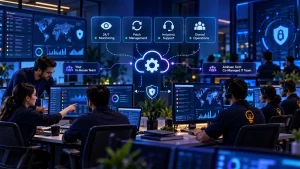
Most IT departments do not become overloaded because of one major project. The pressure usually builds gradually. A company hires more employees, opens another location, introduces new cloud applications, adds new vendors, expands remote access, implements additional cybersecurity controls and becomes increasingly dependent on technology for everyday operations. Each change creates additional work for IT. At the same time, existing responsibilities remain.
Users still need support. Devices still need updates. Servers still need maintenance. Backups still need checking. Network equipment still needs monitoring. New employees still need accounts and access rights. Departing employees still need to be removed from systems. Vendors still need technical coordination. When the team is small, urgent work tends to take priority over important work. An employee who cannot access a critical application needs immediate help. A branch office with a connectivity problem needs attention. A server issue cannot simply wait because the IT team planned to spend the day documenting infrastructure or reviewing firewall policies. Over time, this can create a gap between maintaining the environment and improving it. The IT team may know that documentation needs to be updated, that old devices should be replaced, that patching needs tighter control or that network segmentation should be reviewed. But those projects continue moving down the priority list because operational support consumes most available capacity.
This is one of the situations where co-managed IT can be particularly effective. Instead of replacing the internal team, the external provider takes responsibility for selected operational tasks so that internal staff can spend more time on work that depends on their knowledge of the business. For example, an internal IT manager may continue to own business applications, infrastructure planning, budgeting and technology strategy while an external provider handles routine support tickets, monitoring, patching or after-hours escalation. The objective is not simply to reduce workload. It is to allow the internal team to work at the level where it creates the most value.
Co-Managed IT Is Not Full Outsourcing
The distinction between co-managed IT and complete outsourcing is important. In a fully outsourced environment, an external provider may become the primary IT function for the organization. The provider may manage user support, infrastructure, administration, systems and day-to-day technology operations. That model can work well for organizations that do not want to maintain an internal IT department. Co-managed IT is different because the company intentionally retains its internal capability. The internal IT team continues to hold knowledge of the organization, maintain relationships with management and users, understand business priorities and participate in technical decision-making. The external provider adds resources where the company needs additional support. This means control does not have to move away from the business. An organization may decide that its IT manager must approve all major infrastructure changes. The external provider may be authorized to resolve routine support issues independently but require approval before changing firewall rules, creating privileged accounts or modifying production systems. Another organization may allow the provider to manage backups, patching and infrastructure monitoring while internal IT retains responsibility for applications and network architecture. The exact model should depend on the internal team’s strengths and the organization’s risk profile. This is why clearly defined responsibilities are essential. A successful co-managed environment should make it obvious who owns each function. If a server fails, who investigates first? If a user cannot access Microsoft 365, which team receives the ticket? Who handles firewall configuration? Who monitors backups? Who coordinates with a third-party software vendor? Who responds after business hours? If those responsibilities are unclear, co-management can create more confusion instead of reducing it. The service model therefore needs to be built around accountability, not simply access to additional technicians.
Extending the Team Where Expertise Is Missing
Capacity is only one reason organizations adopt co-managed IT. Specialist expertise is another. Modern IT environments are too broad for a small internal team to have deep expertise in every technology. A company may need knowledge across Microsoft 365, Windows Server, networking, firewalls, virtualization, cloud platforms, backups, endpoint management, identity systems, cybersecurity, wireless infrastructure and business continuity. A strong internal administrator may understand several of these areas well but cannot realistically specialize in all of them. This becomes especially noticeable when the organization begins a major project or experiences a complex incident.
A network redesign may require specialist routing and switching knowledge. A firewall migration may require experience with advanced policies, VPNs and segmentation. A Microsoft 365 problem may require expertise in identity, permissions or tenant configuration. A cloud migration may introduce technical requirements that the internal team has not previously handled. Hiring a permanent specialist for each technology is rarely practical. Co-managed IT allows the organization to access specialist skills when needed without building every capability internally.
This can also improve project delivery. Instead of asking one internal administrator to research and implement an unfamiliar technology while continuing to manage everyday support, the organization can bring in an external engineer who already has relevant experience. The internal team remains involved, understands the implementation and retains ownership, but does not have to solve every technical problem alone. This model is particularly useful during periods of growth. A business may be opening new offices, expanding into additional locations, moving workloads to the cloud or modernizing its network. These projects create temporary demand for more technical resources than the business will need once implementation is complete. Co-managed IT allows that capacity to increase when necessary without permanently increasing headcount.
Keeping Routine Work From Consuming Senior IT Resources
One of the less visible costs of an overloaded IT department is how much senior technical time is spent on low-complexity tasks. An experienced IT manager may be capable of designing infrastructure, managing vendors, improving cybersecurity and planning technology investments. Yet a substantial portion of the day may still be spent resolving printer issues, resetting passwords, installing software or troubleshooting user workstations.
Those tasks are necessary, but they do not always require the organization’s most experienced technical resource. Co-managed IT can redistribute that workload. Routine end-user support can be handled through an external helpdesk while more complex issues are escalated to the internal team. The company still retains internal expertise, but senior staff are interrupted less frequently by first-line support. The same principle applies to repetitive infrastructure tasks. Patch management, monitoring, backup checks, device health reviews and routine administration all require consistency. They may not require strategic decision-making every time they are performed. An external provider can handle these processes while the internal team retains oversight.
This is where co-managed IT can improve operational maturity rather than simply reduce workload. Tasks that previously depended on someone remembering to perform them can become structured processes. Monitoring can be continuous. Tickets can be documented. Escalation paths can be defined. Patch status can be reviewed systematically instead of informally. The internal team gains better visibility without needing to manually perform every operational activity.
After-Hours Support Without Building a Full Shift Structure
Another challenge for internal IT teams is coverage outside normal working hours. Many organizations operate beyond a traditional office schedule. Manufacturing facilities may run multiple shifts. Companies may have international users. Cloud applications may support business processes throughout the day and night. Critical systems may fail at any time. An internal team of two or three people cannot realistically provide continuous coverage indefinitely. Some organizations attempt to solve this by keeping employees informally available after hours. That may work occasionally, but it is not the same as an organized support model. Over time, it can create fatigue and dependency on individual staff members.
Co-managed IT can provide a structured way to extend coverage. The internal team may remain the primary point of ownership during business hours, while the provider handles monitoring, support or escalation outside normal working periods. This can be particularly useful for infrastructure issues. If a server, firewall, internet connection or critical system develops a problem overnight, the external provider can begin investigation rather than allowing the issue to remain unnoticed until employees arrive the next morning. This does not mean every organization needs 24×7 support. The correct model depends on how the business operates and how much downtime it can tolerate. A company that operates only during standard office hours may be perfectly well served by an 8×5 support arrangement with an emergency escalation process. A manufacturing site or internationally distributed company may require broader coverage. The important point is that the organization can choose the coverage it needs without requiring its internal team to provide every hour of support itself.
Co-Managed IT Does Not Remove the Need for Governance
Bringing another technical team into the environment increases the need for clear governance. External engineers may require access to servers, endpoints, cloud platforms, firewalls and network equipment. That access needs to be controlled carefully. Privileged accounts should be managed appropriately. Changes should be documented. Remote access methods should be secured. Responsibilities should be clear. Administrative activities should be traceable. A co-managed model should improve governance rather than create a situation where nobody knows who changed what.
This is particularly important when both teams can administer the same systems. For example, if internal IT and the external provider can both modify firewall rules, there should be an agreed change process. If both teams manage user accounts, permissions should be handled consistently. If the provider monitors backups, internal IT should still have visibility into backup status and recovery procedures. Documentation becomes central to this model.
The organization should maintain accurate information about infrastructure, systems, vendors, escalation contacts, important configurations and operational procedures. This protects both teams. The external provider does not need to depend on one internal employee to explain the environment every time an incident occurs, while the internal team does not become dependent on the provider to understand its own systems. A good co-managed relationship should therefore reduce key-person dependency. If the company’s entire IT environment exists only in the memory of one administrator, that is an operational risk. Co-management can help distribute that knowledge through documentation, shared processes, ticket histories and structured administration.
Co-Managed IT and Cybersecurity Should Be Treated Separately
Organizations should also distinguish between IT management and cybersecurity operations. A provider may manage endpoints, servers, networks, Microsoft 365, backups and user support without necessarily providing continuous threat monitoring. These are related services, but they are not identical. Managed IT primarily focuses on ensuring technology operates reliably. Cybersecurity services focus on reducing risk, identifying threats and responding to suspicious activity. For example, a managed IT provider may receive an alert that a server is offline and begin troubleshooting availability. A Security Operations Center may investigate whether the outage followed suspicious authentication, malicious process execution or unauthorized network activity. A business using co-managed IT should therefore understand exactly which cybersecurity responsibilities are included.
Does the provider manage endpoint security software? Does it review security alerts or simply maintain the application? Are firewall logs actively monitored? Is suspicious activity investigated? Is there a defined security escalation process? If the organization requires continuous threat detection and investigation, a Managed SOC or another dedicated security service may still be necessary. This distinction is especially important because businesses sometimes assume that paying for general IT support means someone is actively watching for cyberattacks. That is not always the case. The scope should be documented clearly so management understands where routine IT operations end and security monitoring begins.
The SLA Should Define How the Two Teams Work Together
A co-managed IT agreement should be more detailed than a simple promise to answer support tickets within a particular timeframe. Response times are important, but they are only part of the operating model. The agreement should explain which systems are covered, what responsibilities belong to the provider, which responsibilities remain internal, what support hours apply, how incidents are prioritized and which situations require escalation. It should also define authority. Can the provider disable a user account if suspicious activity is detected? Can it restart a server without approval? Can it change firewall policies? Can it update a production system? Which actions require authorization from internal IT? These questions should be answered before an emergency occurs. The agreement should also clarify exclusions. A provider may support the underlying server environment but not the business application running on it. It may administer Microsoft 365 but not manage a third-party ERP platform. It may monitor infrastructure but not investigate cybersecurity alerts. Without clear boundaries, the organization may discover during a critical incident that each party believed the other was responsible. A strong SLA therefore reduces uncertainty. The objective is to ensure that both teams know what is expected and how they should work together.
Choosing Which IT Functions to Co-Manage
Not every technical responsibility needs to be moved to an external provider. A better approach is to separate IT responsibilities according to where they create the most value. Tasks that depend heavily on business context often make sense to keep internally. The internal IT team may be best positioned to understand business applications, departmental priorities, executive requirements, budgeting, technology strategy and relationships with key users.
Operational activities may be easier to share. These could include helpdesk support, patching, infrastructure monitoring, backup monitoring, routine system administration, endpoint support and after-hours coverage. Specialist technical work can also be a strong candidate for co-management. Networking, firewall administration, cloud infrastructure, complex Microsoft environments or major technology projects may require expertise that the organization needs occasionally rather than every day. This produces a much more balanced model than treating outsourcing as an all-or-nothing decision. The internal team remains close to the business while gaining access to resources that would otherwise be difficult or expensive to maintain permanently. The ideal division will be different for every company.
A small organization with one IT manager may use the provider for helpdesk, networking and escalation support. A larger IT department may use co-management primarily for after-hours coverage or specialist infrastructure work. The important issue is whether the arrangement solves a genuine capacity or expertise problem.
What a Good Co-Managed IT Relationship Should Achieve
A successful co-managed relationship should make the internal team stronger. Support requests should be handled more consistently. Senior employees should have more time for strategic projects. Infrastructure should receive better monitoring. Specialist skills should be available when required. Documentation should improve. The organization should be less dependent on individual employees. At the same time, internal IT should retain visibility.
The organization should know what systems are being managed, what changes are being made, what issues are recurring and how the provider is performing. Co-managed IT should not create a black box around the technology environment. If the internal team no longer understands its own infrastructure or cannot operate without the provider, the relationship has moved away from true co-management. A healthy model creates shared capability. The provider adds resources, processes and specialist expertise. Internal IT contributes business context, organizational knowledge and strategic ownership. Together, the two teams should be able to provide a level of coverage and capability that would be difficult for either to deliver independently.
Final Thoughts
Organizations do not always need to choose between managing everything internally and outsourcing everything externally. For businesses that already have an IT team, co-managed IT can provide a practical middle ground. It allows the organization to keep internal knowledge, maintain control over strategic decisions and continue developing its own technical capability while gaining access to additional resources where they are most useful. This could mean extra helpdesk capacity, stronger infrastructure monitoring, specialist networking support, after-hours coverage, assistance with complex projects or simply another technical team available when internal staff reach their limits. The model works best when responsibilities are clearly defined, governance remains strong and the external provider is treated as an extension of the internal team rather than a replacement for it. The goal is not to remove ownership from internal IT. It is to give that team enough capacity, expertise and support to operate more effectively.
Co-Managed IT Services From Ambsan Technologies
Ambsan Technologies provides Managed IT and IT consultancy services that can complement existing internal IT teams. A co-managed engagement can be structured around the areas where an organization requires additional support, including remote end-user support, infrastructure administration, network support, system monitoring, troubleshooting, technical consultancy, specialist IT resources and cybersecurity support. For organizations with an existing IT manager or internal IT department, Ambsan can operate as an additional technical resource while the internal team continues to maintain business ownership and strategic control. The objective is not to replace the people who already understand the organization. It is to extend their capability.
Visit www.ambsan.com to discuss a co-managed IT support model for your organization.